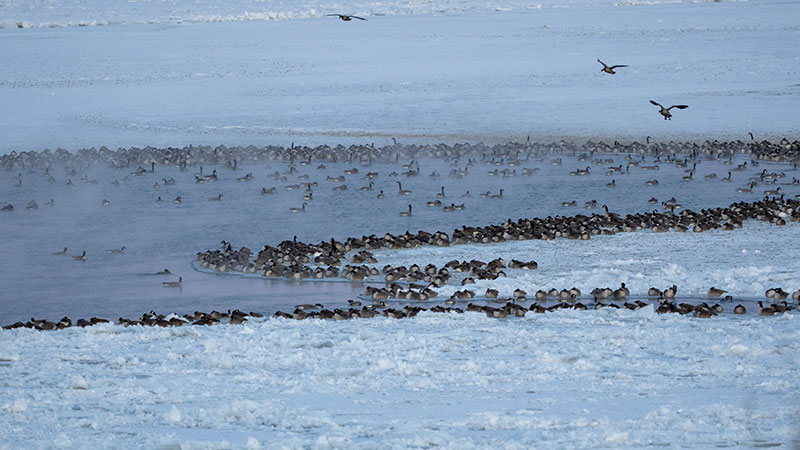
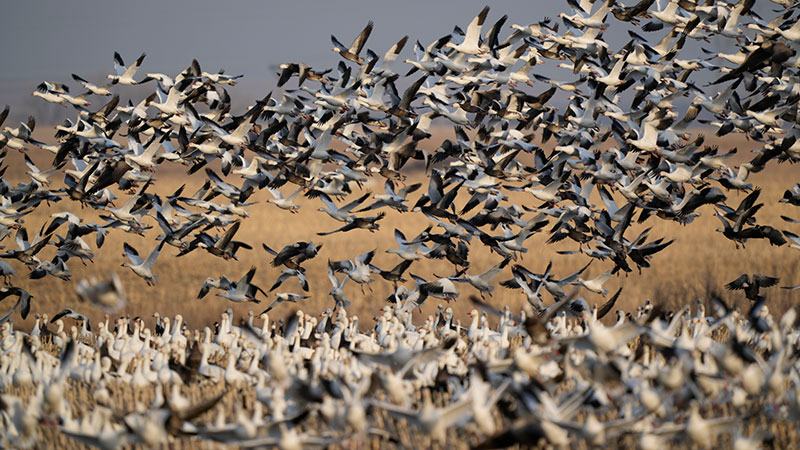
The North Dakota Game and Fish Department’s annual midwinter waterfowl survey in early January indicated about 135,000 Canada geese and 9,500 mallards in the state.
Mason Ryckman, Department migratory game bird biologist, said numbers were pretty similar to years when Lake Sakakawea is still open, besides the record year (2024) of 300,000-plus Canada geese in 2024.
“Unlike last year when Lake Sakakawea was completely frozen at the time of the survey, this year a portion of the lake remained relatively ice free from Garrison Dam to the mouth of the little Missouri River,” Ryckman said. “We were able to count 39,000-plus Canada geese on the lake this year. We would have probably overwintered more waterfowl if we didn’t receive the snow we did in late November and early December. It likely pushed birds south of the border due to not having access to waste grain in ag fields. However, the snow didn’t last long, which helped the birds that did stay until the time of the survey.”
During the 2026 survey, an estimated 109,112 Canada geese were observed on the Missouri River and Lake Sakakawea, another 16,894 on Nelson Lake in Oliver County, and an additional 8,500-plus geese in other parts of the state. Ryckman said Game and Fish staff and partners with the U.S. Fish and Wildlife Service recorded an additional 9,500 mallards across the state.
The 10-year average (2017-26) for the midwinter survey in North Dakota is 115,950 Canada geese and 13,400 mallards. The survey helps biologists gauge wintering distribution of waterfowl in North Dakota, and other states throughout the Central Flyway.
Elk, moose and bighorn sheep applications must be submitted online before midnight March 25.
To apply online, visit the Game and Fish website, gf.nd.gov. Paper applications are not available. Hunters who have received a license through the lottery in the past are not eligible to apply for that species again.
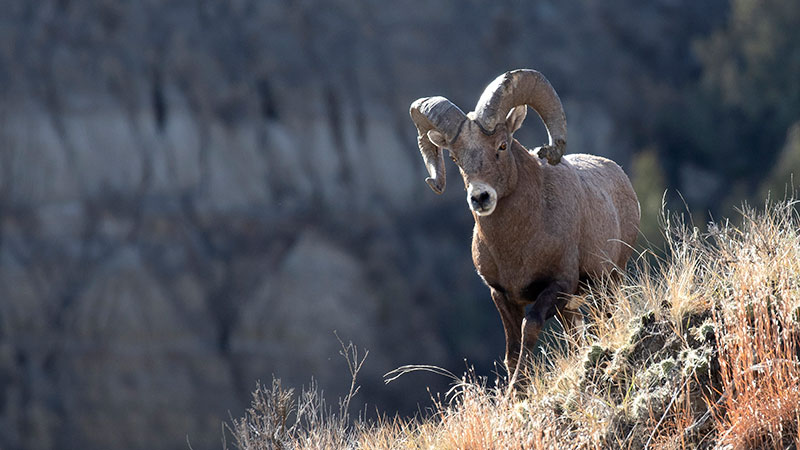
In 2025, 27,279 people applied for the 288 moose licenses; 25,388 applied for the 956 elk licenses; and 21,221 applied for the seven bighorn sheep licenses.
Wildlife managers urge outdoor enthusiasts to consider where they recreate during North Dakota’s leanest months to spare already stressed animals simply trying to survive the elements.
This advice is true during any Northern Plains winter.
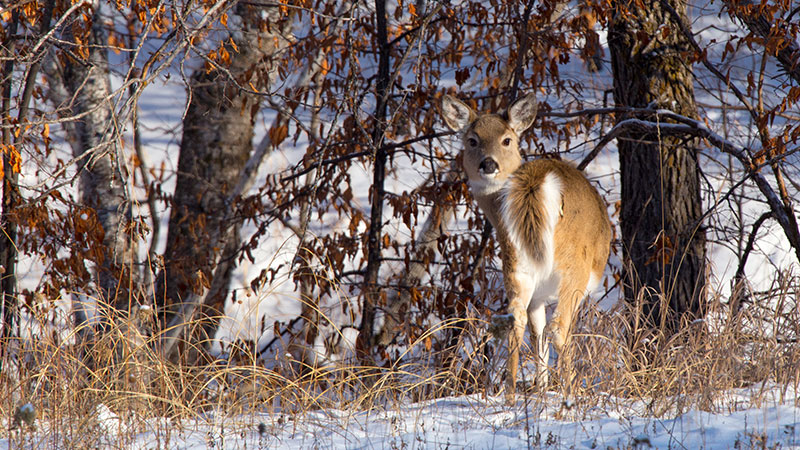
Game and Fish Department managers understand North Dakotans want to get outdoors and have fun in winter because we have several months of it. Even so, the tougher the winter is, it is important that people riding snowmobiles, shed hunting, cross-country skiing or doing whatever are cognizant about where wildlife are and to view them from a distance.
That means waiting to shed hunt until later in the spring so that you’re not pushing deer in and out of thermal cover where they’re trying to just conserve energy. Animals forced into the open are exposed to the elements a lot more, which adds further stress. Also, people need to realize that harassing wildlife from snowmobiles or other machines is illegal in North Dakota.
It’s common for snowmobilers and others to ride in areas where snow has accumulated, such as near shelterbelts and other wooded habitat because that’s where the drifts are, but people also must realize there could be deer or other wildlife within those areas to get out of the weather. So, every time animals are pushed from those areas, it increases the amount of energy they expend to survive the next day.
These same warnings, for shed hunters, skiers and others, also apply on Game and Fish Department owned or operated wildlife management areas where many animals gather to weather the winter months.
North Dakota’s spring light goose conservation order opens Feb. 21 and continues through May 10.
Residents must have a 2025-26 (valid through March 31) or 2026-27 (required April 1) combination license; or a small game, and general game and habitat license. Resident youth under age 16 only need the general game and habitat license. The 2026-27 license is available for purchase beginning March 15. In addition, all hunters need an electronic waterfowl restoration stamp.
Nonresidents need a 2026 spring light goose conservation order license. The cost is $50 and valid statewide. Nonresidents who hunt in spring remain eligible to buy a fall season license. The spring license does not count against the 14-day fall waterfowl hunting season regulation.
Nonresident youth under 16 can purchase a license at the resident fee. A federal duck stamp is not required for either residents or nonresidents. Yet, like resident hunters, nonresidents also need an electronic waterfowl restoration stamp.
Resident and nonresident licenses are available online at the North Dakota Game and Fish Department website, gf.nd.gov.
Hunters must register annually with the Harvest Information Program prior to hunting in each state. The HIP number obtained for North Dakota’s spring conservation order is also valid for North Dakota’s fall hunting season. The number can be obtained online on the Game and Fish website.
The spring conservation order is only open to light geese – snows, blues and Ross’s. Species identification is important because white-fronted and Canada geese travel with light geese. The conservation order is closed to whitefronts, Canada geese, swans and all other migratory birds.
For more information on regulations refer to the 2026 Spring Light Goose Hunting Regulations on the Department’s website.
North Dakota citizens with an interest in supporting wildlife conservation programs are reminded to look for the Watchable Wildlife checkoff on the state tax form.
The state income tax form gives wildlife enthusiasts an opportunity to support nongame wildlife like songbirds and birds of prey, while at the same time contributing to programs that help everyone enjoy all wildlife.
The checkoff — whether you are receiving a refund or are having to pay in — is an easy way to voluntarily contribute to sustain this long standing program. In addition, direct donations to the program are accepted any time of year.
Winter anglers must clean up the ice after fishing. This not only applies to trash, but fish as well.
It is not only unsightly, but it is illegal to leave fish, including minnows used for bait, behind on the ice. According to state fishing regulations, when a fish is caught, anglers must either immediately release the fish unharmed, or reduce them to their daily possession.
It is common practice for some anglers to fillet fish on the ice, which is allowed if fish entrails and other parts are removed from the ice and properly disposed of at home.
In addition, all trash, including aluminum cans, cigarette butts and Styrofoam containers, must be packed out and taken home.
The North Dakota Game and Fish Department no longer mails subscriber renewal notices for North Dakota OUTDOORS as the majority of subscribers renew their subscriptions online at gf.nd.gov.
To check the status of your subscription, the subscription expiration date appears on the address label on the back of the magazine.
Also of note, don’t miss an issue of NDO by changing your address online on the Department’s website. Each month we receive a number of magazines with “no longer living at this address” return labels. Act now to ensure you stay updated with all the latest issues from the Game and Fish Department.
Wiedmann Named to Wall of Fame
The Wild Sheep Foundation named Brett Wiedmann, North Dakota Game and Fish Department big game management biologist, as the 19th member of the Wild Sheep Biologist’s Wall of Fame.
Wiedmann was honored in January at the foundation’s awards banquet in Reno, Nev. This prestigious honor, established in 2006, recognizes peer wild sheep biologists for career-long dedication to wild sheep conservation, sound biological management, and quality hunting opportunities across North America.
“Over the past 24 years, Brett has demonstrated exceptional passion, commitment, and vision in building and managing North Dakota’s bighorn sheep program,” said Bill Haase, Department wildlife division chief. “His leadership has been instrumental in improving herd management, elevating the profile of North Dakota’s bighorn sheep resource, and enhancing hunting opportunities and the quality of rams harvested by hunters.”
Haase added that this recognition reflects not only Wiedmann’s outstanding career accomplishments, but also the long-term commitment of the Department to science-based wildlife management and conservation excellence.