

Outliers Do Exist
By Paul Bailey, Russ Kinzler and Aaron Slominski
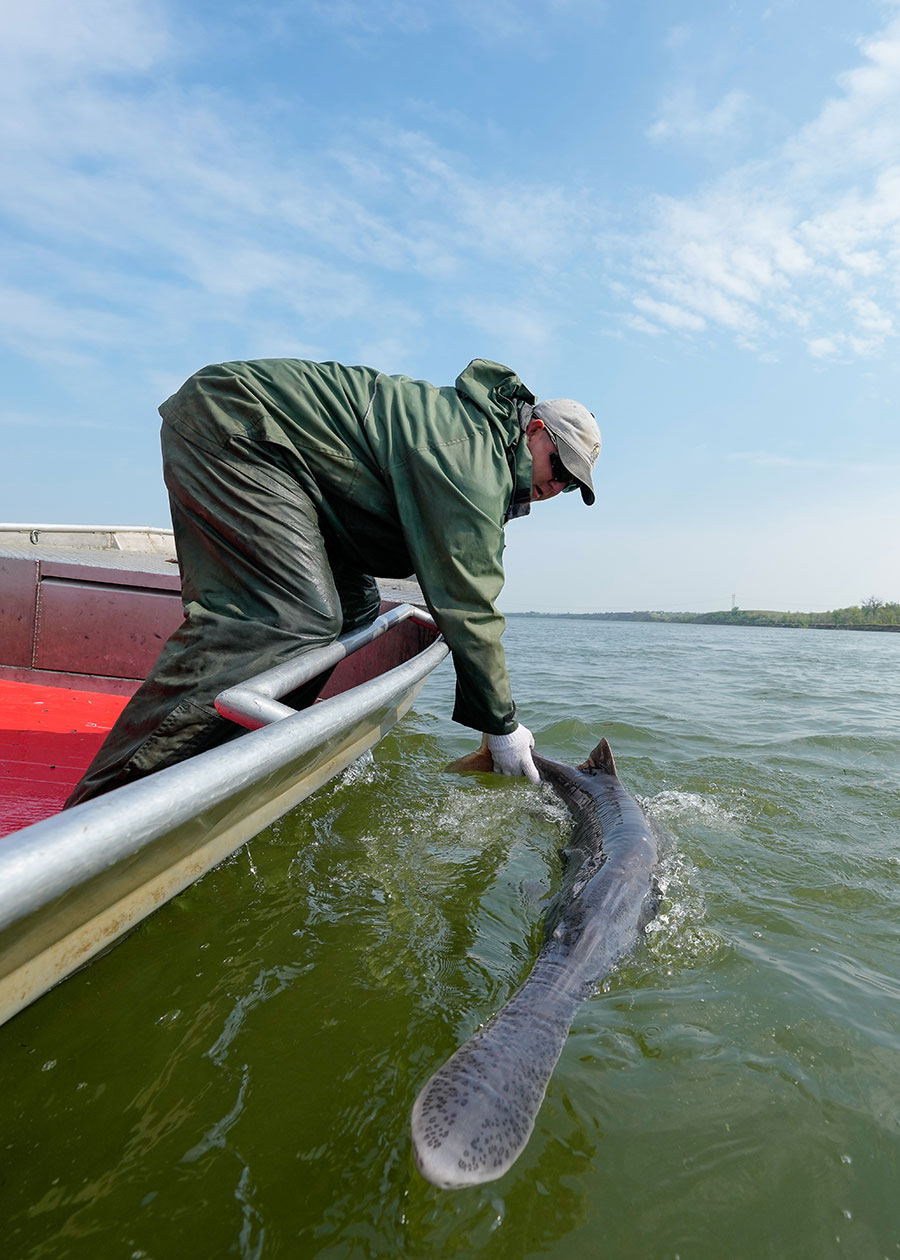
Obtaining an estimate of exploitation (the percentage of fish anglers harvest annually from a population) is most often the primary reason the North Dakota Game and Fish Department undertakes a fish tagging study. Assessing exploitation allows us to determine if current harvest regulations are compatible with the long-term sustainability of that fish population, an important piece of information for maintaining the best fishing possible for anglers to enjoy.
However, lots of other information is revealed through tagging studies including the timing of angler harvest, how anglers treat fish of various sizes (harvest or release), spawning periodicity (how often does an individual spawn), spawning site fidelity (does an individual fish return to the same spawning site year after year or venture somewhere else), and fish movement.
Fisheries biologists care about fish movements because it is crucial for understanding survival and reproduction. Biologists and anglers alike love learning about where a fish may have traveled throughout its life.
Fish tend to move to give themselves the best chance of survival (like finding food, escaping predators, and locating preferred temperatures and habitats) and reproduction. As such, movements generally follow a stereotypical pattern for that species of fish.
For example, paddlefish are great long-distance swimmers due to their torpedo body shape, powerful and deeply forked tail, and highly vascularized flesh rich in lipids and myoglobin. Lake Sakakawea’s paddlefish tend to wander throughout the reservoir in search of zooplankton forage. Then, every 1-2 years mature male paddlefish, and every 2-3 years female paddlefish, undertake a spawning migration, sometimes several hundred miles long, from Lake Sakakawea and into the Yellowstone River to spawn.
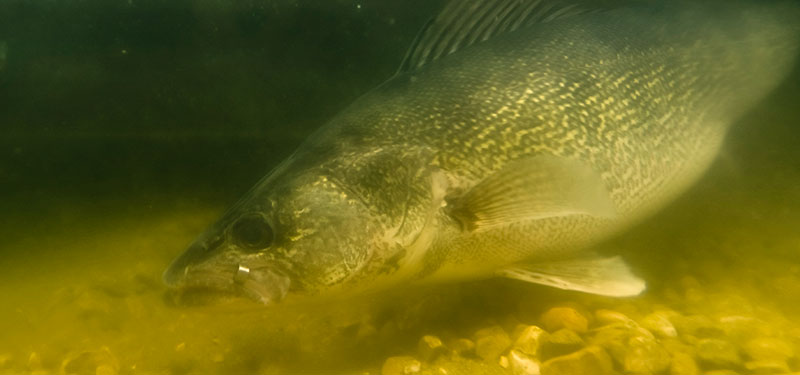
Walleye, on the other hand, tend to lead much more sedentary lives. They lack the extremely hydrodynamic body shape of great long-distance swimmers and have poorly vascularized flesh low in lipids and myoglobin designed for short bursts of movement rather than sustained swimming. This leads to walleye having wonderful, white, flakey flesh prized as table fare.
This combination of body shape, muscle physiology and palatability is also contrasted in the avian world among great long-distance flyers (snow geese) and their more sedentary counterparts (pheasants).
Walleye #8351
Another example of both spawning site fidelity as well as some movement, was this 20.1-inch female walleye tagged during the spawn at Snake Creek on May 18, 1996. It was recaptured during spawning operations on May 19, 1997, May 15, 2002, and May 10, 2005. It was also caught and released by an angler on June 19, 2005, near Douglas Bay and then caught and harvested by an angler on Aug. 6, 2005, near Mckenzie Bay some 40-plus miles upstream of where it spawned that spring. It was 26 inches long when caught.
Walleye #68206
Anglers on Lake Sakakawea are harvest orientated but there are lots of examples of fish being released. This walleye was a 14.1-inch male tagged at White Earth Bay on April 21,.2021. It moved downstream and was caught and released by an angler near Saddle Butte Bay on July 25, 2021. On July 17, 2022, it moved farther downstream and was caught and released by another angler near Nishu Bay, 75 river miles downstream from where it was tagged. On June 5, 2025, it moved back upstream and was caught and released by an angler in the Van Hook arm and was 18.2 inches long at that time.
Walleye #68351
Another example of a fish being caught and released multiple times with a unique ending is this 20.8-inch female walleye tagged April 21, 2021, at White Earth Bay. It was caught and released by an angler on Oct. 19, 2023, near Hunts Along Bay and three days later was caught and released by another angler near Hunts Along Bay. On Jan. 29, 2024, it was caught and released at Bear Den Bay by the same angler who caught it three months earlier Near Hunts Along Bay.
Walleye #10710
Most walleye tag returns happen within a few years of when they were tagged. This walleye was a 20.5-inch female tagged May 8, 1997, at Parshall Bay and was caught and harvested by an angler Oct. 5, 2025, in the Van Hook Arm. This fish apparently avoided anglers and Game and Fish Department spawning nets for 28 years after it was tagged. This is an extreme example of fish recaptures from tagging studies.
Northern Pike #NDPIKE 1217
Northen pike on Lake Sakakawea tend to be caught near where they were tagged but this pike moved both upstream and downstream. This 15.3-pound female was tagged April 14 2017, at Deepwater Bay. It was caught and released on April 27, 2019, during the walleye spawn at Parshall Bay, approximately 21 miles from where it was tagged. On May 18, 2020, it was caught and released by an angler at Douglas Bay some 59 miles from where it was last caught.
Walleye #67833
While most walleye don’t move far from where they were tagged, a few move extreme distances, and some leave the lake all together. An example of a fish moving upstream out of Lake Sakakawea is walleye #67833, a 22.8-inch female tagged April 18, 2021, at White Earth Bay. This fish moved 277 river miles upstream and was caught and released by an angler below Fort Peck Dam on Aug. 21,2023.
NDGF fisheries supervisors Paul Bailey, Bismarck, Russ Kinzler, Riverdale, and Aaron Slominski, Williston, authored this piece.