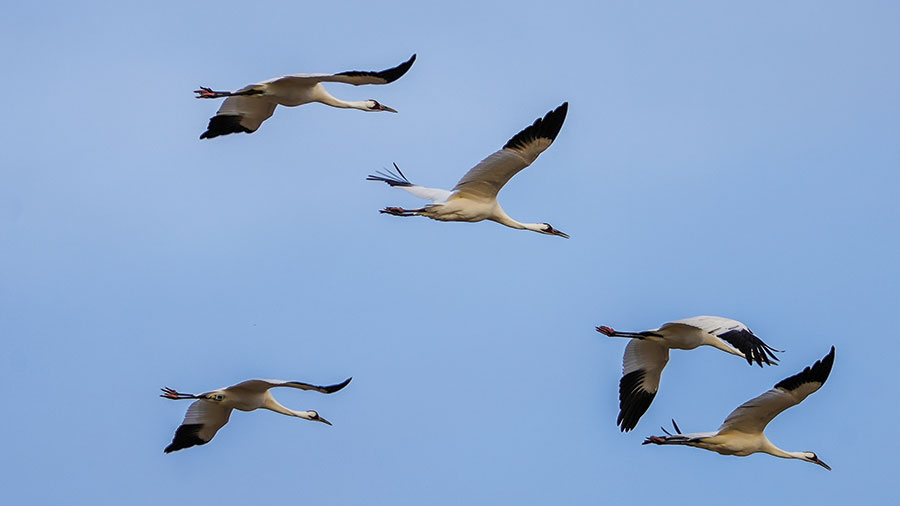
The recovery of their main migratory population, from fewer than 20 birds in the 1940s to roughly 550 to 560 today, stands as one of the great conservation successes in North America. Growth has averaged about 4% per year over eight decades, though the rate has slowed to roughly 2-3% in the last decade. These birds remain rare enough that every stretch of good habitat matters.
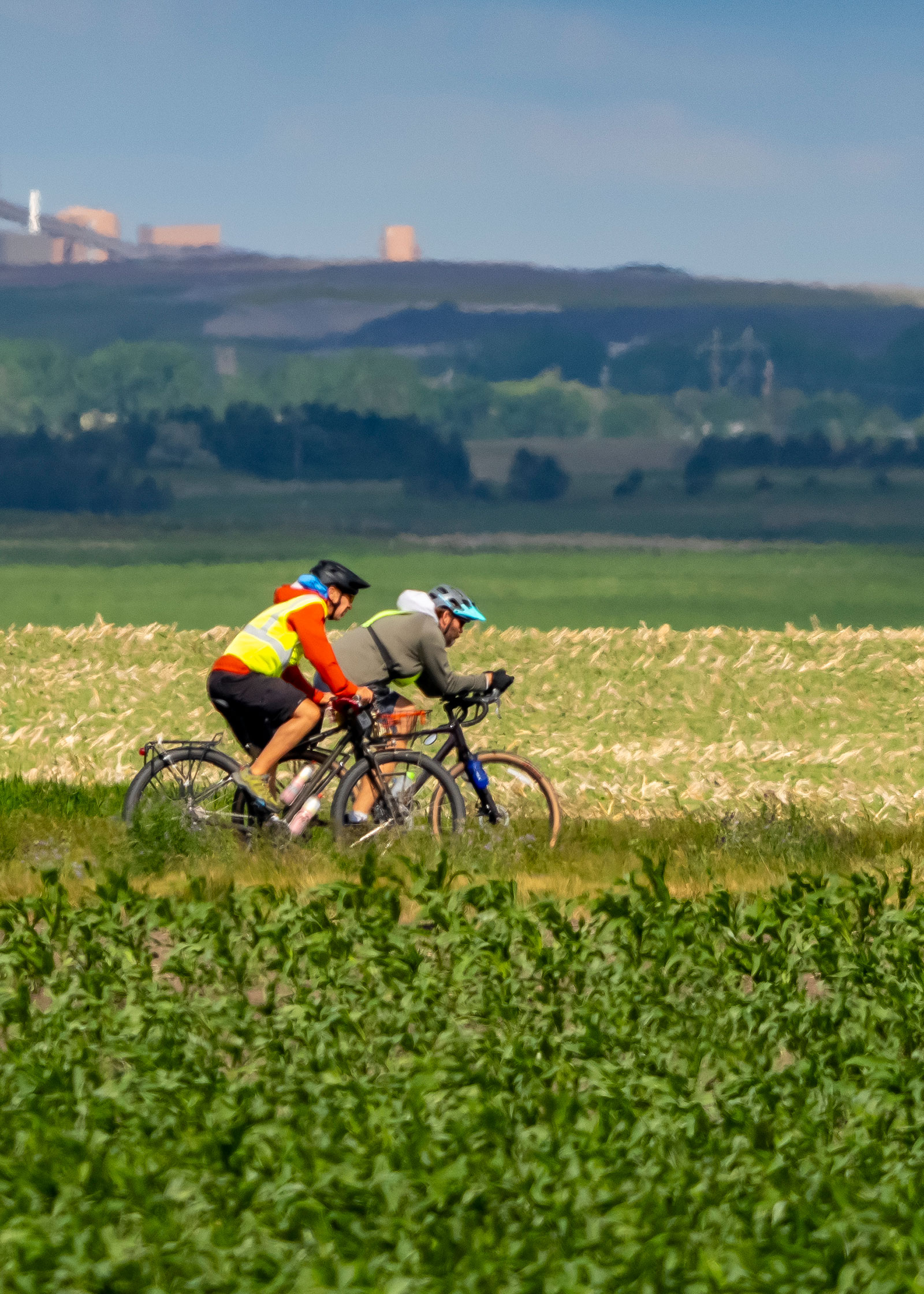
The two men set out on May 11, 2026, for this ride that would take them the full length of the “migration highway” under their own power, from the Texas coast to Central Saskatchewan. They averaged 50 to 60 miles a day on gravel bikes, while a support vehicle carried gear and helped with logistics. Their goals were simple but demanding: feel the distance the cranes travel, see every mile of the corridor, and bring the story of that landscape and the plight of the whooping crane to light.
North Dakota sits at a critical spot within that story. Here the Missouri River turns west, and the whooping cranes bend west as well. South of the state the birds rely on a mix of river bottoms, playas and managed wetlands. However, north of Lake Sakakawea they shift almost entirely to prairie potholes the rest of the way.
As they pedaled, the men felt a shift in the landscape as well. Climbing out of flatter prairie and into the Missouri Coteau, the hills began to roll, and the bird life changed.
“We got into big chunks of grass, and it just made me elated,” Caven said. “North Dakota is really neat because that’s where the whooping cranes really bend west. And I also feel like we’ve entered the province of sparrows.”
In the good native prairie remnants south of Bismarck the grassland bird community exploded around them. Vesper sparrows, savannah sparrows, grasshopper sparrows and Nelson’s sparrows all called out along their path.
The men conducted daily surveys to track everything they saw and heard as they rode. At the first grassland or wetland they reached each morning, they would record plants in a 10- by-10-meter plot and count birds, noting species, for 10 minutes. They conducted their surveys wherever they could, but at wildlife management areas they reveled in their ability to get away from the road and out into the habitat. During these surveys, they logged nearly 350 plant species and more than 150 bird species by the time they reached central North Dakota.
Forsberg was reminded of the past during one particular stop near McLean Bottoms Wildlife Management Area. Four years earlier he had flown over, and then explored the same spot during a historic April blizzard.
“It’s really cool to be back here now, four years later, at a completely different time of year,” Forsberg said, “I’m getting to wander around in a place that I’ve only stepped foot on when there was 4 feet of snow.”
When he was there before, whooping cranes had been stuck on that WMA, surviving by picking waste grain on the ridges where the wind had blown the snow clear. This time, the hills were green, and life flourished in this oasis. Seeing it again in the context of this journey showed him how much these birds rely on every acre of preserved land.
The men described how along the way they’ve seen both loss and causes for hope. Across the Great Plains, roughly 2 million acres of grassland and temporary or seasonal wetlands disappear each year. Invasive grasses, especially smooth brome and crested wheatgrass, have spread through many remnants in the Dakotas, and human intervention continues to alter the landscape by converting diverse grasslands and wetlands into simplified, single-use agricultural fields and development.
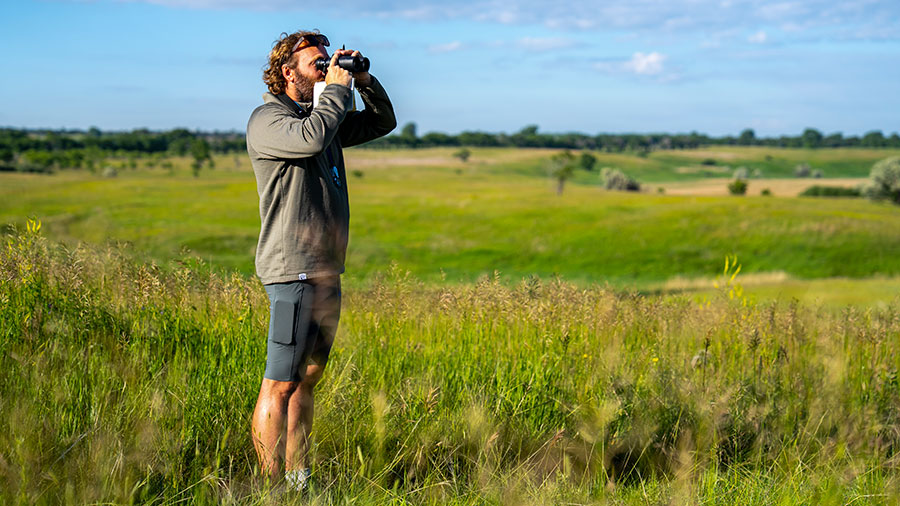
Andy Caven surveys bird species at the MacLean Bottoms Wildlife Management Area. This stop is part of a larger project chronicling plant and bird species along the whooping crane migration path.
Yet despite this, they still found high-quality prairies where native warm-season grasses dominated, and the bird community felt complete. Protected areas, waterfowl production areas, WMAs and national wildlife refuges function as safe havens along the corridor.
“If we didn’t set those aside back in the day, there wouldn’t be anything left,” said Forsberg. “Those are just this string of pearls up and down the heart of the continent.”
They also noted in their discussions that working ranches keeping grass on the ground matter just as much.
“If it doesn’t pay, it doesn’t stay,” Forsberg said, observing that sustainable ranching and conservation need each other.
Forsberg often returned to the deeper reason for the trip.
“The muse is the whooping crane, this lovely bird that was nearly lost, but there’s a lot more to it than that,” he said.
The ride let them experience the landscape the way the cranes do, slowed down, with every sense engaged.
“We’re hoping to not just see this but feel it,” Caven added, “and feel the miles between these patches just like the monarch butterfly or a greater yellowlegs or a whooping crane would when they migrate.”
Forsberg also spoke about the human side of the journey.
“Doing this under our own power allows us to tell our story, the crane’s story, and most importantly of all, it helps us to tell other people’s stories that we come in contact with along the way and lift them up,” he said.
They publicized their route online before leaving and invited many people to join in on the journey as they went.
Successful conservation is about scale and repeatability. Individual birds, animals, and acres matter, but the totality of the ecosystems they make up is what will keep vulnerable species thriving for generations to come. For Forsberg and Caven, this journey is about sharing the scale of the Central Flyway, its challenges, and piecing the links of this ever-important chain of habitats together for all of us to see. That part of the story doesn’t end when they step off their bikes in Saskatchewan; it will continue as long as people value what the cranes need and what the land is meant to be.