

NORTH DAKOTA OUTDOORS MAGAZINE

An Ancient Fish in a Modern River

Zachary Eshleman
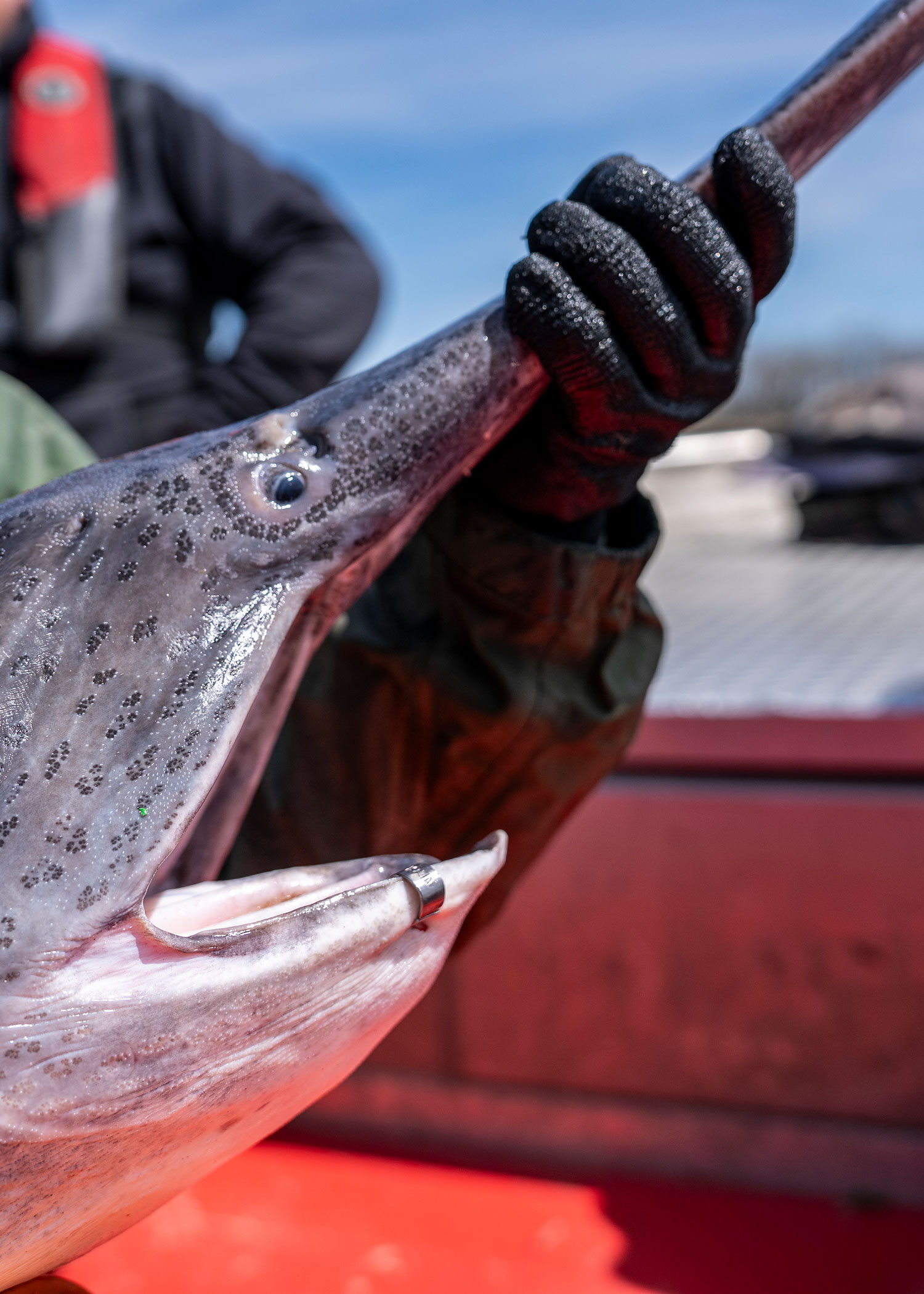
Tagged paddlefish

It was a Wednesday morning in mid-May when I joined Paul Bailey on the Missouri River for a ritual that has been repeated every spring for the last 21 years. It was a warm, clear day as we set off south of Washburn, with the water flowing glass-smooth under our boat.

“A good day to fish for paddlefish is also a good day to find paddlefish,” remarked Bailey, North Dakota Game and Fish Department south central fisheries supervisor in Bismarck, as the other members of our small crew prepared the nets for a day’s work. He said nice days with low winds tend to yield the best results.

The tagging strategy was simple, but I wouldn’t describe it as easy. As filter feeders, these fish spend much of their time swimming into the current, maximizing the flow of water through their mouths and capturing zooplankton through highly developed rakers on their gills. So, we floated with the current and spread a gill net across a section of the river to meet fish on our way downstream. The net hung from a series of floats that acted as bobbers, showing us exactly when we caught a fish.

The first thing that surprised me about this process was the sheer number of fish we came across in such a short period of time. Looking out at the river, it’s hard to picture these huge fish spread across your field of view, but that’s exactly how it was.

It’s not unusual for this team to tag 100 fish in a day, and we would regularly get a few in the net at the same time. With some of the fish weighing more than 90 pounds, it’s easy to see how just getting them on the boat and moving them around can quickly become a labor-intensive task.

By capturing as many fish as possible, marking them with a metal tag and noting length, weight and physical anomalies such as a bent rostrum, the fisheries team formed a picture of the health and behavioral tendencies of this unique population.

The paddlefish is often called a living fossil. It is closely related to sturgeons and has existed in North American freshwater systems for more than 100 million years. With a history like that, a 20-year population study may seem like little more than a blip on their timeline. Still, to understand why monitoring this fish matters to the Department, you need to understand its anatomy and its ties to our changing river systems.

When you pull one from the water, the first thing that stands out is the large paddle, or rostrum, for which it is named. It feels solid and immovable, but it is actually a complex piece of the sensory system that helps this fish succeed in the turbid, flowing water it calls home.
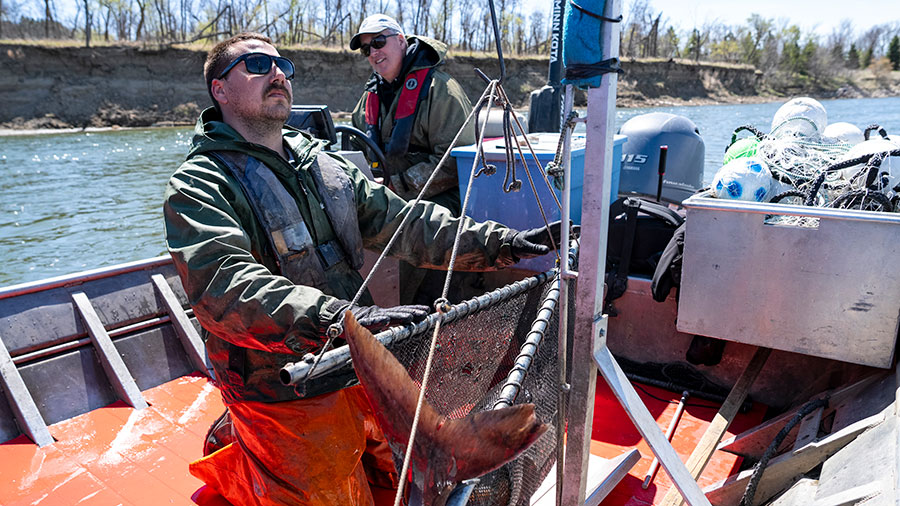

“Paddlefish don’t have really good vision, but what they have instead are these ampullae of Lorenzini,” said Bailey. “They’re these tiny little electro-sensory receptors that go down the paddlefish’s gill cover and then all the way up their rostrum.”

This system acts as a sixth sense. It lets them detect the tiny electrical signals given off by the muscles and nerves of their zooplankton prey so they can locate groups moving through the river.

“After a paddlefish detects food, it opens its trapdoor-like mouth, and it has a free-floating jaw that can open pretty wide. On a large paddlefish, you might be able to fit a volleyball in there,” described Bailey, “and they just filter the water as they go.”

Biologist weighing paddlefish

Lucas Rott, Department fisheries supervisor in Riverdale, weighs a paddlefish before releasing it into the Missouri River upstream of Bismarck.

Being one of the few native filter feeders in North American fresh water makes this fish unique enough. Move back from the rostrum and mouth, though, and you find another feature that sets the species apart. There’s an opening on the gill cover called a spiracle. Paddlefish share this feature with sharks. The opening helps with water flow when the mouth is closed or the fish is resting. Paddlefish have no musculature to pull water across the gills. They need moving water to breathe.

“Paddlefish are an obligate ram respirator,” said Bailey, “so the paddlefish often will have its mouth open just a little bit as it is swimming to facilitate water movement over its gills.”

This also means that if you accidentally catch one, it can’t breathe properly while being held still in non-flowing water. It’s important to release it quickly and move it in the water to help it recover.

“They also have this unique structure on top of the head called a parietal eye, located here on their forehead,” Bailey explained, moving up from the spiracle. “It’s a kind of abstract X-shaped feature. It’s not an eye in the sense that it forms an image, but it is a photoreceptor.”

He said researchers are not entirely sure what this receptor tells the fish, but it likely signals seasons and day length to trigger hormonal changes, among other things.

“This eye is also sensitive to detecting shadows passing over the fish,” he continued, “so it could be useful, especially when this fish is little, for avoiding predation from birds and other hazards that might be overhead. Also, the zooplankton that paddlefish feed on are sometimes drawn to certain light conditions, so that could be another use.”

The idea of avoiding predation is interesting when you’re talking about the largest fish in our waters. Still, it takes a couple of years before their size keeps them out of danger. This transition has led to camouflage coloration and a musculature built for both long-range swimming and quick bursts of energy. That mix of traits also explains why they are shaped so differently from other fish in this area.

“They have this deeply forked tail and a very narrow but muscular portion at the rear of the fish called the caudal peduncle,” explained Bailey. “This is really indicative of a fish that’s a good long-distance cruiser. They also have this kind of torpedo body shape with their dorsal fin located much more rear of center. And that’s indicative of a fish that is a really good accelerator. So, paddlefish are capable of some pretty good burst swimming speeds when needed. They’re even capable of launching themselves completely out of the water. For a fish this large, it’s a pretty impressive feat.”

All of these adaptations have led to long-term success across a huge range that stretches from southwestern New York to central Montana, south to Louisiana and even to parts of Alabama and Texas. They also show how specialized paddlefish are for conditions that are becoming rarer in today’s dammed and altered river systems.

The paddlefish is now listed as threatened or vulnerable in several states. One of the interesting things about studying them in North Dakota is how our two populations show the effects that damming rivers and changing habitat can have on these fish.

There are two distinct populations in the state: a breeding population in Lake Sakakawea and the upper Missouri and Yellowstone rivers, and the population south of Garrison Dam. The lower group is believed to be sustained only through entrainment (fish flowing through the dam).
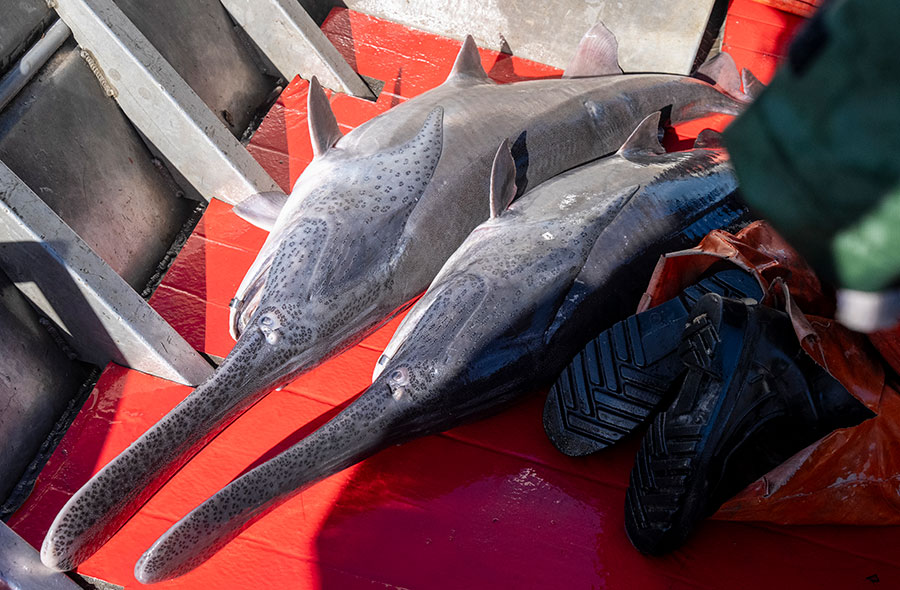
Tagged paddlefish on boat deck before being released

“We don’t believe we have any natural reproduction occurring down here. We’ve seen no evidence of that,” said Bailey, speaking of the area between Garrison Dam and Lake Oahe. “We’ve got much cooler water thanks to the bottom discharge of the lakes. That keeps those temperatures much lower than paddlefish need for reproductive purposes.”

According to Bailey, the upper population exists in a system much closer to what the fish is built for. That is why it has been able to breed and maintain a population that even allows for responsible harvest.

All this brings us back to the original question: Why is monitoring paddlefish so important for our fisheries as a whole?

The answer is that the paddlefish’s specialized adaptations make them a strong indicator of the health of the systems they live in. They are not like carp that can be tossed into any system and take over. They are built to succeed when rivers function as they did before human intervention. Their main food source is also the main food source of young game fish we know and love.

“Paddlefish can be considered one of the canaries in the coal mine when it comes to our fisheries,” said Bailey. “They feed low in the food chain. So, if you’ve got healthy paddlefish that are in great physical condition, feeding on abundant zooplankton, that’s a really good indicator that you’ve got good primary productivity in that fishery and that other fish species that rely on zooplankton are going to be doing well also. I mean, walleye are king. And after the walleye hatch, one of the main things they’re feeding on is zooplankton.”

Currently, the data on the population here look promising. The Garrison Reach population has held fairly steady since monitoring began, and the same goes for the upper population. Reproduction seems a little erratic year to year, but with a lifespan that sometimes exceeds 100 years, year-to-year swings do not affect the population as much as overall trends.

Paddlefish have moved through the waters of what is now North Dakota for more than 100 million years, surviving events that wiped out many other species on land and in the water. Their specialized anatomy reflects a deep adaptation to a very different Missouri River than the one that exists today. These living fossils now depend on both ecological conditions and human decisions to remain part of our world. Understanding them is critical to how we manage the river going forward. It will also help determine whether this ancient creature continues to endure or slowly fades from the waters it has inhabited for so long.