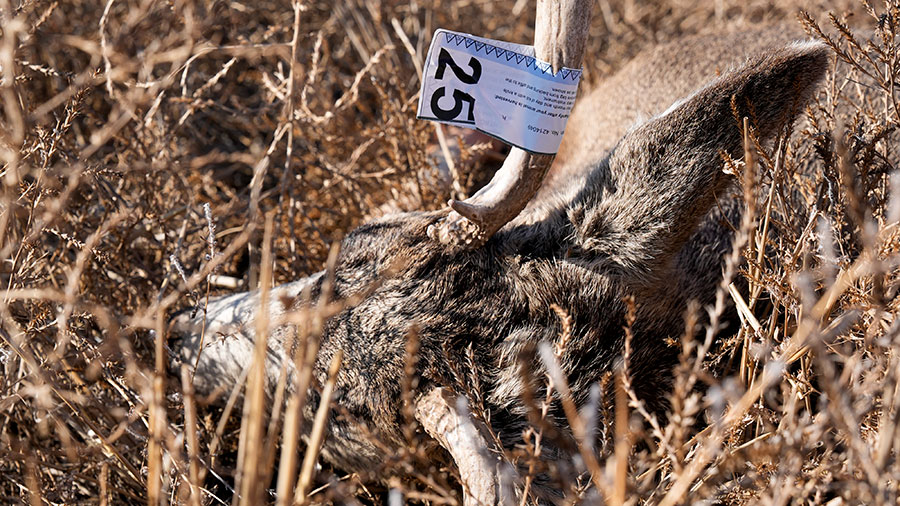
A total of 36,353 North Dakota deer hunters took approximately 20,877 deer during the 2025 deer gun hunting season, according to a post-season survey conducted by the state Game and Fish Department.
Game and Fish made available 42,300 deer gun licenses last year. Overall hunter success was 57%, with each hunter spending an average of 4.9 days in the field.
Hunter success for white-tailed deer was 53% for antlered and 45% for antlerless whitetails.
Mule deer license holder success was 82% for antlered and 82% for antlerless mule deer.
Hunters with any antlered or any antlerless licenses generally harvest white-tailed deer, as these licenses are predominantly in units with mostly whitetails. Though, mule deer made up a greater proportion of the harvest in the Slope and Missouri River hunting units. Any antlered hunters had a success rate of 65%, while any antlerless hunters had a success rate of 56%.
Game and Fish issued 11,598 gratis licenses in 2025, and 9,453 hunters harvested 4,452 deer for a success rate of 47%.
A total of 797 muzzleloader licenses were issued, and 665 hunters harvested 215 white-tailed deer (102 antlered, 113 antlerless). Hunter success was 32%.
A total of 27,341 archery licenses (24,553 resident, 2,494 nonresident white-tailed deer, 294 nonresident any deer) were issued in 2025. In total, 22,944 bowhunters harvested 6,610 deer (5,590 whitetails, 1,020 mule deer) for a success rate of 29%.
The North Dakota Association of Soil Conservation Districts has completed the first enrollment cycle for the Governor’s Legacy Soil Health and Habitat Program. The program was launched through a $6.5 million Outdoor Heritage Fund grant awarded in December 2025, with the North Dakota Game and Fish Department serving as a co-applicant. The program was developed with input from agricultural and conservation partners and is designed to support grassland restoration, soil health, and wildlife habitat across the state.
The program provides five-year agreements that include annual rental payments, cost-share for grass establishment, and a first-of-its-kind $10 per acre crop insurance credit for unproductive cropland converted to grassland habitat. Producers who enroll acres into the department’s Private Land Open To Sportsmen program receive additional incentives.
Demand for the program was strong, with 458 applications submitted and nearly 20,000 acres offered for consideration, totaling approximately $10.5 million in requests, well above the available grant funding. Interest in PLOTS was also high, with nearly 6,000 acres offered for walk-in public access. Following review and ranking, the highest scoring applications were selected, fully obligating all grant funds through more than 9,000 acres of habitat and access projects for 2026.
The response demonstrates significant producer interest in grassland restoration and soil health practices, as well as strong support for a state-led program. The Governor’s Legacy Soil Health and Habitat Program was developed following recommendations from the Game and Fish Department’s 2024 Habitat and Access Summit, which identified the need for a state program to help offset ongoing losses in the federal Conservation Reserve Program.
The North Dakota Association of Soil Conservation Districts and the department are working with partners to explore long-term funding options to continue and expand the program.
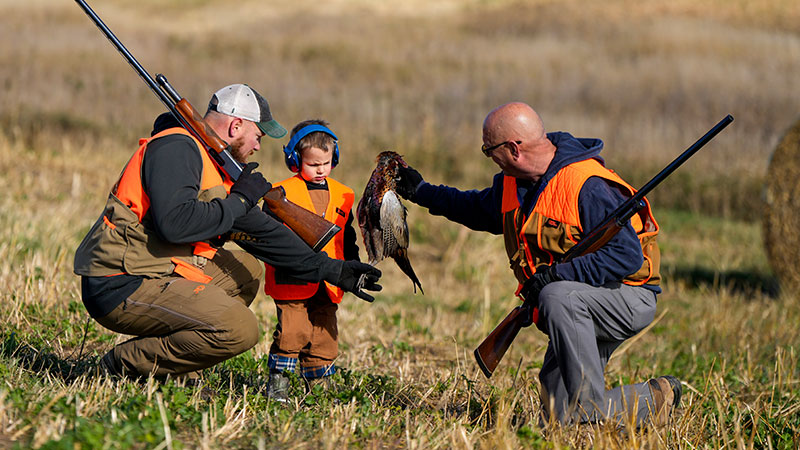
North Dakota’s 2025 upland bird harvests were down for pheasants, grouse and gray partridge compared to 2024.
“We were not surprised by a decrease in pheasant harvest in the fall of 2025 based on decreases of chicks in our late summer roadside counts. Chick production was negatively impacted by the cool, wet nesting season and these juvenile birds are often what make up a significant portion of a hunter’s bag. However, adult pheasant densities remain high due to good survival from the mild winter,” said RJ Gross, North Dakota Game and Fish Department upland game biologist.
Gross said given the number of roosters remaining on the landscape post-season, access was likely the most limiting factor for pheasant hunter success.
Last year, 53,008 pheasant hunters (down 4%) harvested 344,975 roosters (down 3%), compared to 55,401 hunters and 357,018 roosters in 2024.
Counties with the highest percentage of pheasants taken were Hettinger, Divide, Williams, Stark and McLean.
A total of 18,241 grouse hunters (down 16%) harvested 55,539 sharp-tailed grouse (down 24%), compared to 21,660 hunters and 73,010 sharptails in 2024.
Counties with the highest percentage of sharptails taken were Divide, Hettinger, Mountrail, Adams and Bowman.
Sharp-tailed grouse were down 38% in last year’s summer roadside brood counts.
“In addition to cool, wet weather in June, which is unfavorable for chick survival, we suspect sharptail may have been impacted by West Nile virus because they declined from spring surveys to late summer surveys. Those declines appeared to have hampered the rebounding population, and the 24% drop in sharptail harvest reflects this,” Gross said.
Last year, 18,343 hunters (down 16%) harvested 50,445 gray partridge (down 25%). In 2024, 21,887 hunters harvested 67,465 partridge.
Counties with the highest percentage of gray partridge taken were Stark, McLean, Hettinger, Williams and Divide.
“Although hunters harvested fewer pheasants in 2025, we are optimistic after yet another mild winter, that the high pheasant population should carry through to 2026,” Gross said.
However, since much of the fall forecast depends on nesting and brood-rearing success, hunters should stay tuned.
While the North Dakota Game and Fish Department recognized National Safe Boating Week in May, agency officials encourage boaters to follow safe boating practices during all open water months.
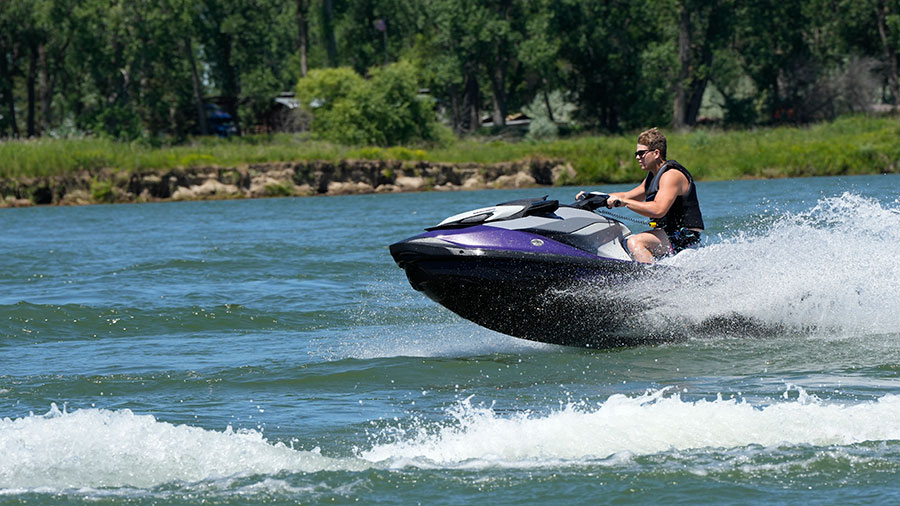
A boat should have enough U.S. Coast Guard approved wearable life jackets on board for all passengers. North Dakota law requires all children ages 10 and younger to wear a personal flotation device while in boats less than 27 feet in length. The law also requires all personal watercraft users to wear a life jacket, as well as anyone towed on skis, tubes, boards or other similar devices.
However, state law allows an individual engaged in barefoot skiing or surfing to wear a wet suit (a life preserver must be on board the towing vessel), and a person who is at least 16 years of age can windsurf or boardsail without wearing a PFD. Water users should make sure to wear life jackets of the appropriate size and in good condition.
Coast Guard statistics show that drowning was the reported cause of death in three out of every four recreational boating fatalities in 2024, and that 87% of those who drowned were not wearing life jackets.
It is also important children wear a PFD while swimming. Swimmers should know the water’s depth, as serious injuries can occur from diving. Large objects hidden below the water’s surface can lead to significant injury.
North Dakota boaters are also reminded that Class A and Class 1 vessels are required to have one hand, mouth or power-operated whistle audible for at least one-half mile. This regulation also applies to kayaks, canoes, paddleboards and jet skis.
Regulations to help ensure safe boating this summer are found online.
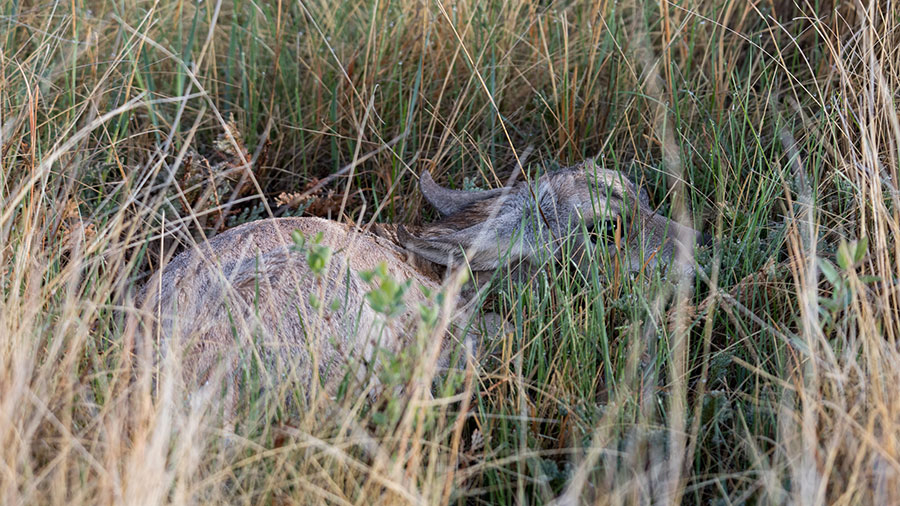
The North Dakota Game and Fish Department offers a simple message to the well-intentioned who want to rescue what appear to be orphaned baby animals this time of year: don’t touch them. Whether it is a young fawn, duckling, cottontail rabbit or a songbird, it is better to leave them alone.
Often, young animals are not abandoned or deserted, and the mother is probably nearby. Young wildlife are purposely secluded by adults to protect them from predators.
Anytime a young wild animal has human contact, its chances of survival decreases significantly. It’s illegal to take wild animals home, and captive animals later returned to the wild will struggle to survive without possessing learned survival skills.
The only time a baby animal should be picked up is if it is in an unnatural situation, such as a young songbird found on a doorstep. In that case, the young bird can be moved to the closest suitable habitat.
Citizens should also steer clear of adult wildlife, such as deer or moose that might wander into urban areas. Crowding stresses animals and can lead to a potentially dangerous situation.
In addition, motorists are reminded to watch for deer along roadways. During the next several weeks young animals are dispersing from home ranges, and with deer more active during this time, the potential for car deer collisions increases.
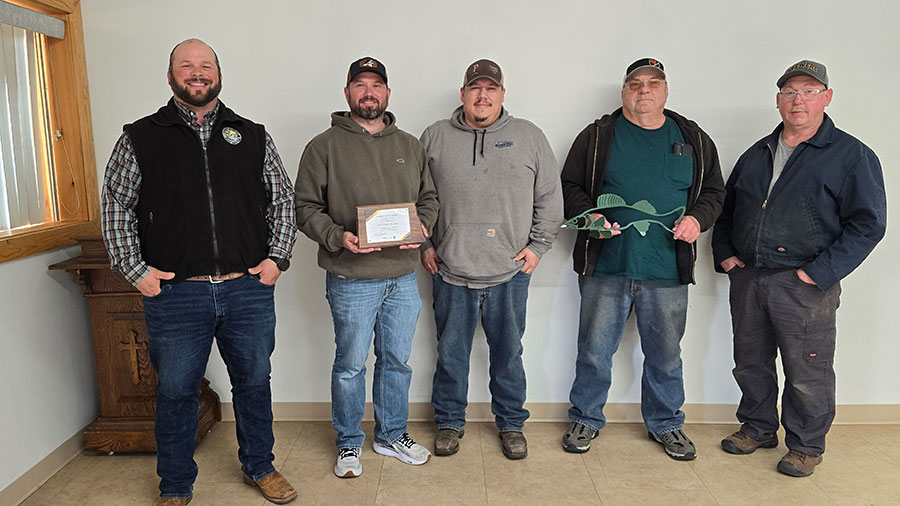 Left to Right: Wesley Erdle, Game and Fish Department fisheries development project manager, Brett Nodland, Elliott Hintz, Delvin Zahn and Kurt Gillig.
The North Dakota Game and Fish Department recognized the Zap Park Board with the 2026 certificate of appreciation for the difference the group has made on their local fisheries and facilities.
“Since the 1980s, the park board has been involved and has cooperated with Game and Fish on development and maintenance of a popular and valuable recreation site at Beaver Creek Bay on Lake Sakakawea,” said Wes Erdle, Department fisheries development project manager.
“Activities have included the construction and installation of a main boat ramp, a low-water ramp, several courtesy docks, a vault toilet, paved access road and parking area and numerous other amenities that have made this site a popular destination and public recreation area for many. In fact, the main boat ramp was reconstructed last year, and the park board incurred a large expense in cooperating on that project.”
Edle added that the Zap Park Board has assumed the important role of managing and maintaining all of these facilities throughout the year.
“As we all know, maintaining anything is just as important as the initial construction and the park board does an outstanding job in performing these duties,” he said.
Warden Raasakka Retires
Mike Raasakka, longtime North Dakota Game and Fish Department game warden in Stanley, retired after nearly 39 years with the agency.
“Mike worked tirelessly to protect wildlife and those who enjoy it. From the busy waters of the Van Hook Arm to the deer, moose and waterfowl on the uplands, Mike was always there to do his job professionally and with the utmost dedication,” said Scott Winkelman, Department enforcement division chief. “Mike’s experience will be missed by many in his district and the Department.”