On the Conservative Side
Ron Wilson
Bill Haase believes there are reasons to be optimistic. Deer were in good shape going into last winter, the third mild one in a row, which could lead to good fawn production in spring and summer where quality habitat is available.
“So, I think we’re going to start to see some pretty good recovery this year in the deer population in parts of the state,” said the North Dakota Game and Fish Department’s wildlife division chief.
Team that glass-half-full optimism with a conservative allocation of deer license numbers, the lowest in roughly 50 years, and that boost deer need to rebound to agreeable numbers is a possibility.
The Department made available 39,100 licenses to hunters for the 2026 season, down 3,200 from last year. Muzzleloader licenses were also reduced, and antlerless deer gun licenses were not made available in several hunting units.
Deer numbers are what they are today because of the prolonged effects of the staggering winter of 2022-23 and epizootic hemorrhagic disease outbreaks across a landscape with increasingly limited habitat in parts of the state.
“You have to keep in mind that when we did have a lot more habitat on the landscape and deer had to endure a really bad winter, like in 2011, recovery was much quicker because of the habitat available,” Haase said. “Today, deer are recovering, but it’s slow. Where there’s habitat, deer are doing better and I think hunters will see that.”
Even so, Haase cautions, the new norm for a rebounded deer population in North Dakota might not be what hunters remember from the good old days of 10 to 15 years ago.
Much of the decline in the total number of deer gun licenses in 2026 compared to last year was in the eastern third of the state, and the majority of those were antlerless licenses.
“That’s by design to try to help that herd recover, but I can’t guarantee that’s going to result in more deer next year because the habitat conditions are not that great right now,” Haase said. “Fawn production is a big part of deer survival. And if you look around the eastern part of the state, you can see the cover for those deer is limited compared to what it used to be, say, 10 years ago.”
The main drivers of North Dakota’s deer population, Haase said, are habitat, weather and disease.
“But we can control harvest through our license allocations and that’s where we’re trying to be as conservative as we can,” he said. “Alongside that, we’re really focusing on habitat programs such as the Governor’s Legacy Soil Health and Habitat Program. We’ve seen a lot of interest in this pilot program from landowners and we’re really hoping to expand it.”
The Governor’s Legacy Soil Health and Habitat Program is administered by the North Dakota Association of Soil Conservation Districts, with local delivery through soil conservation districts and partners.
“Also, CRP is offered again, and I saw they just had another open enrollment, which is another habitat opportunity for landowners,” Haase added. “We also have a long list of landowners who are interested in enrolling in our Private Land Open To Sportsmen program or doing habitat improvements.”
Some of the tools wildlife managers employ to determine license numbers made available to hunters each year include harvest rates, aerial surveys, depredation reports, hunter observations, input at advisory board meetings and comments from the public, landowners and agency staff.
“We certainly read all the hunter comments from our hunter surveys, and I would say the one comment we’ve heard more than any is that people want us to be conservative with deer license sales right now,” Haase said. “They’d rather have us issue fewer licenses to allow the deer population to recover as much as possible.”
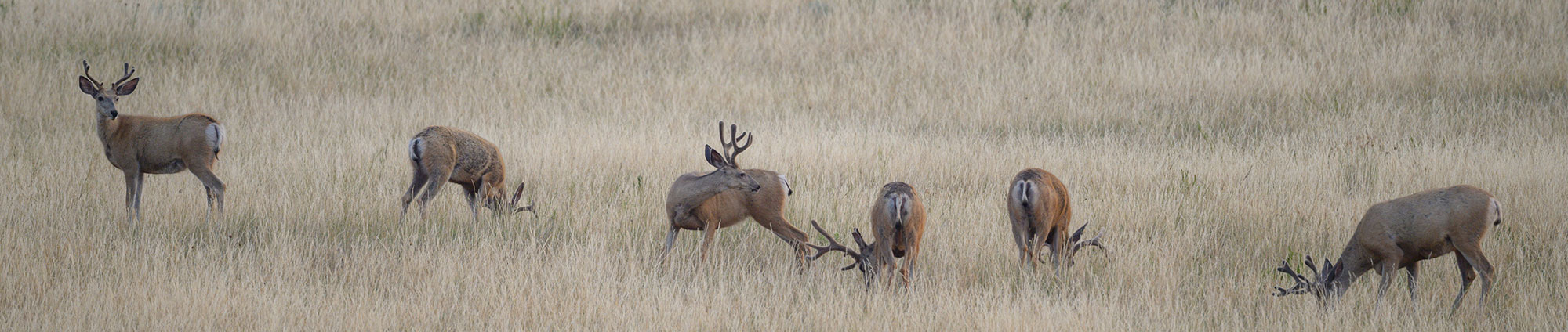
While white-tailed deer numbers are down from where agency and big game biologists would like them to be, on the good news side of things, the spring mule deer survey showed western North Dakota’s is 31% higher than last year.
“It was a nice increase in the mule deer population, but our population was pretty low going into it. Luckily, we had perfect conditions … we had good moisture last year, so those deer had good fat reserves going into winter and did really well,” Haase said. “Most of the fawns must have survived because fawn production was low last year, so it’s a good sign to see an increase in the population.”
Even so: “We’re not quite where we want to be with that population,” Haase added. “So, we remained a little bit on the conservative side with mule deer gun license allocations for this coming fall.”