Roosevelt, before any other title, was a birder. As a young boy he was fascinated with birds and amassed an extensive collection of taxidermy specimens. He was ever the observer of nature. Not just viewing and hearing birds but immersing in the experience of being in their company. Growing up in the East, he knew the Eastern meadowlark well, which looks identical to a Western meadowlark, but “utters nothing but a harsh, disagreeable chatter.” How could two birds so alike sound so different. The Western meadowlark being “one of our sweetest, loudest songsters … the plains air seems to give it a voice, and it will perch on the top of a bush or tree and sing for hours in rich, bubbling tones.” The multitudes that visit the library can still immerse themselves in the meadowlark song if they take a moment to listen to the badlands. However, meadowlarks, like so many other grassland birds, are less common today than when Roosevelt had an ear tuned to the landscape.
Roosevelt was captivated with another bird of the badlands more often heard than seen. “Sometimes in the early morning, when crossing the open, grassy plateaus, I have heard the prince of them all, the Missouri skylark. The skylark sings on the wing, soaring over head and mounting in spiral curves until it can hardly be seen, while its bright, tender strains never cease for a moment.” On one occasion, Roosevelt sat on his horse and listened to the bird singing overhead, nonstop, for 15 minutes. Today, biologists have documented this bird, currently named Sprague’s pipit, continuously displaying in the sky for nearly 3 hours. It is indeed a sweet songster, and once you recognize its song, a stiff neck is sure to follow trying to spot the resilient little bird, often 50 to 100 yards overhead. In Roosevelt’s era, pipits were much more common in the western two-thirds of the state, even abundant in places. Today, they are few and far between, but in the expansive native grasslands bordering the badlands, one might still listen to the sky and with a bit of luck, hear the prince sing.
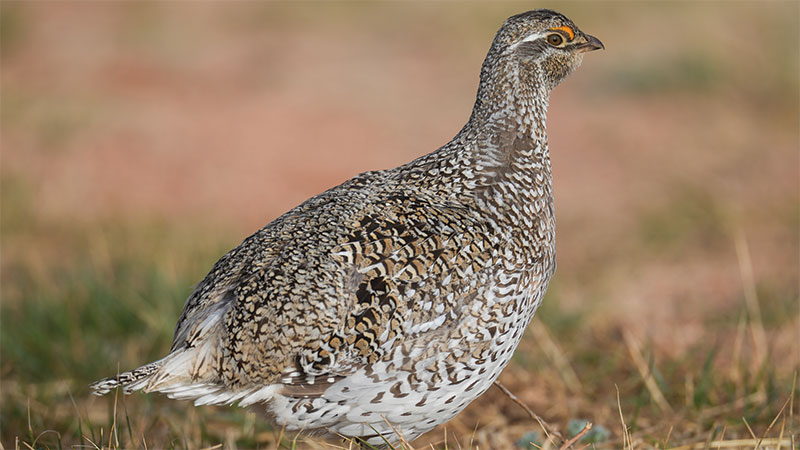
Sharp-tailed grouse
Sharp-tailed grouse were “the most plentiful of the feathered game to be found on the northern cattle plains” and remain fairly common today, where intact grasslands persist. Roosevelt enjoyed eating grouse, noting they were “very good eating from about the middle of August to the middle of November, after which it is a little tough.” Today, this native upland game bird is pursued far less frequently than the nonnative ring-necked pheasant, which did not become established in the state until the 1930s. Visitors to almost anywhere in the badlands will likely encounter both sharp-tailed grouse and pheasants. What they will not find, but Roosevelt often did, are greater sage grouse. “It is only found where the tough, scraggly wild sage abounds, and it feeds for the most of the year solely on sage leaves, varying this diet in August and September by quantities of grasshoppers.” Roosevelt said sage grouse were “very easy marks, but require hard hitting to bring them down, for they are very tenacious of life.” Today, sadly, these big upland birds have all but disappeared and none were counted on traditional leks in North Dakota in spring 2025.
Mallards, widgeon, pintails, teal, shovellers and wild (Canada) geese were frequent sources of fresh meat. Some waterfowl were found in little pools or the streams near Roosevelt’s Elkhorn Ranch, but Roosevelt would often make trips farther east where “The prairie round about is wet, at times almost marshy, especially at the borders of the great reedy slews. These pools and slews are favorite breeding-places for water-fowl, especially for mallard, and a good bag can be made at them in the fall, both among the young flappers (as tender and delicious birds for the table as any I know), and among the flights of wild duck that make the region a stopping-place on their southern migration.”
Roosevelt shot his first white goose (unknown if it was a snow or Ross’s) in the badlands. Geese were far less abundant in his time, partly from market hunting, but also the natural constraints of their habitat. Historically, snow geese fed on short grasses and sedges in the marshes of the Gulf Coast. In the 1970s, snow and Ross’s geese discovered waste grain in harvested rice, corn and wheat fields. This new food source led to improved body condition, increased survival, and a population explosion with numbers reaching 20 million birds by 2007, levels that greatly damaged the Arctic breeding grounds. One can only imagine what Roosevelt would say about this situation. He would have surely marveled at the clever endurance of the geese, while alerting the unintended consequences that follow when we reshape the land.
The latter half of the 19th century was a period when unregulated market hunting fueled the decline of many bird species. Shorebirds, in particular, were shot not by the hundreds per shooter, but by the thousands. Their fate was unfortunate, sealed by their own natural instincts to flock tightly together, yielding large returns with one shot, but also because they are delicious. Roosevelt said “There are two or three species of birds tolerably common over the plains which we do not often regularly hunt, but are occasionally shot for the table. These are the curlew, the upland or grass plover, and the golden plover.”
Long-billed curlews were “one of the most conspicuous features of plains life.” By the end of Roosevelt’s presidency, they had nearly vanished from the East. Yet he had observed them near Elkhorn Ranch, and numerous accounts from naturalists in the late 1800s and early 1900s located them across many parts of the state. Today, long-billed curlews are primarily found in Golden Valley, Billings, Slope and Bowman counties. They’re easy to identify because “they are never silent, and their discordant noise can be heard half a mile off. Whenever they discover a wagon or a man on horseback, they fly toward him, usually taking good care to keep out of gunshot. They then fly over and round the object, calling all the time, and sometimes going off to one side, where they will light and run rapidly through the grass; and in this manner they will sometimes accompany a hunter or traveller for miles, scaring off all the game.” Curlews behave much the same today, but now it’s your vehicle if you stop along the road, or a rancher on an ATV. You know one when you see one.
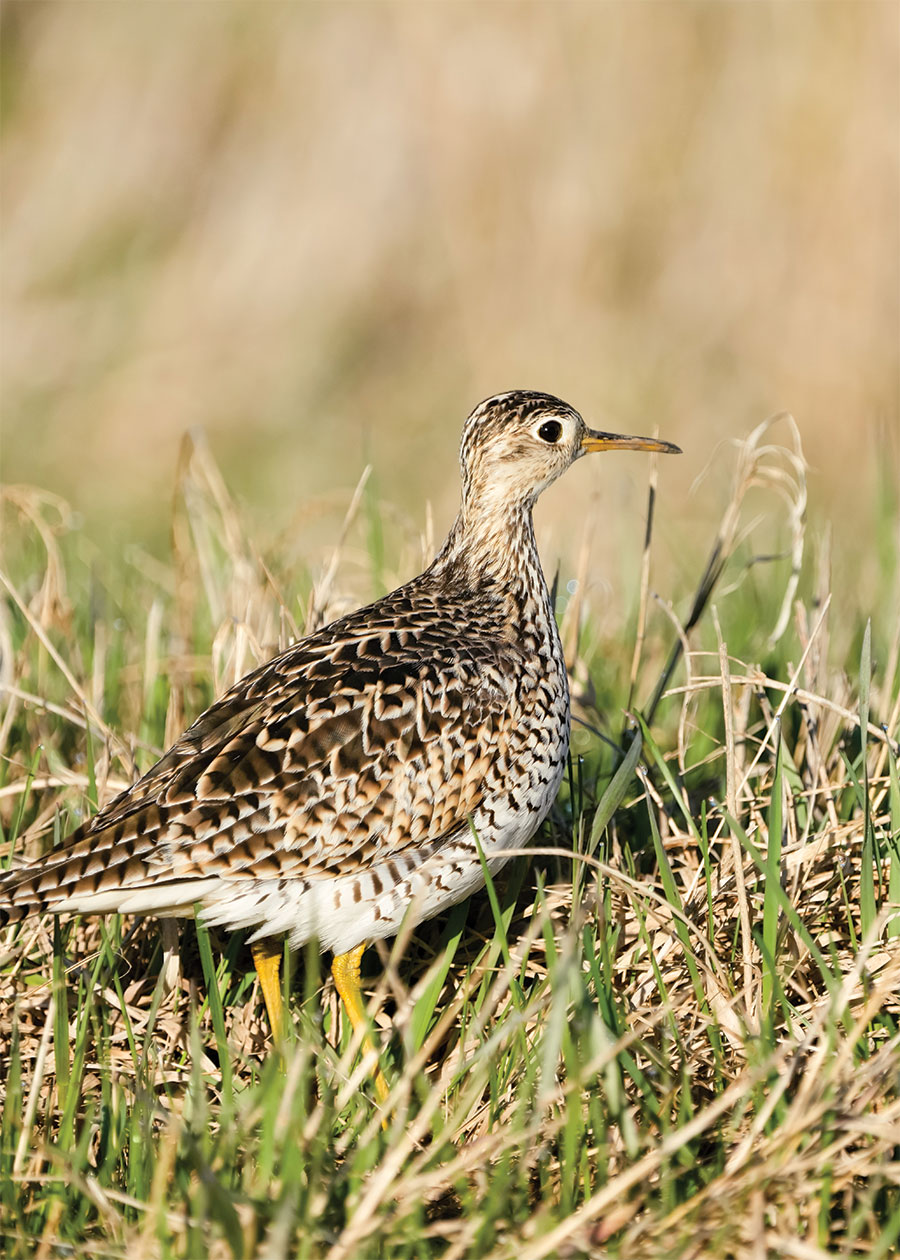
The grass plover, now named upland sandpiper, was found in the same places as the curlew but Roosevelt considered them “less wary, noisy and inquisitive.” Upland sandpipers were one of the most sought-after game by market hunters, some later acknowledging it is a wonder the species survived at all. Today, the Central Flyway is the stronghold for this bird and North Dakota ranks second out of 22 states for hosting the highest percent of the global population. Upland sandpipers are commonly seen perched on fenceposts in North Dakota today, a sight that Roosvelt likely never witnessed due to the scarcity of fences at the time.
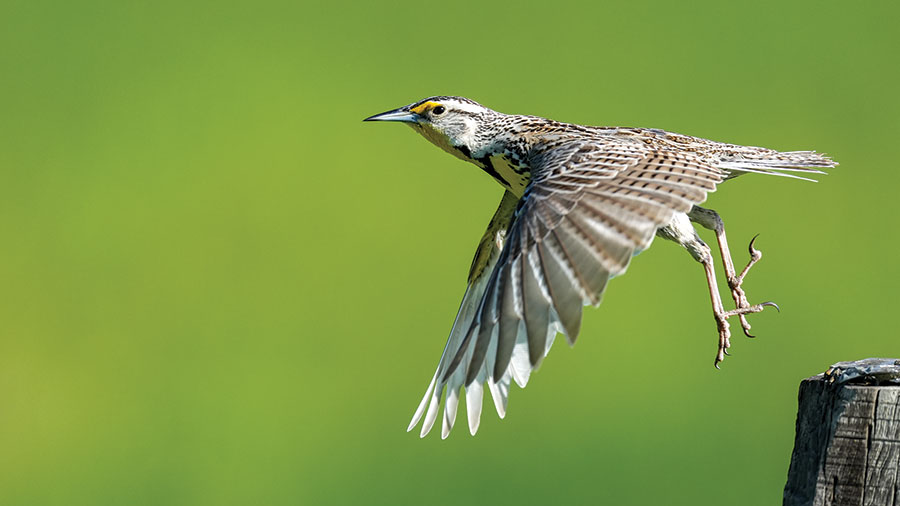
Meadowlark
The golden plover, now known as American golden-plover, “is only found during the migrations, when large flocks may sometimes be seen. They are delicious eating, the only ones I have ever shot have been killed with the little ranch gun, when riding around the ranch, or travelling from one point to another.” Golden plovers have never been seen in abundance during migration, but today it would be challenging to find one within the vicinity of Roosevelt’s ranches.
Other shorebirds Roosevelt found were “yellowlegs, yelper (lesser yellowlegs), willet, marlin (marbled godwit), dough bird, stilt, and avocet” though they were more plentiful east of the badlands. Of these, one is gone forever, the Eskimo curlew. Dubbed the dough bird because when shot their skin would split open, revealing so much fat it resembled bread dough. Smaller than a long-billed curlew but larger than an upland sandpiper, Eskimo curlews migrated north from South America and made stopovers in the central Great Plains, especially on burned prairies, on their way to northern breeding grounds.
While North Dakota was not a primary stopover area, Eskimo curlews were believed to occur in parts of the state. Certainly, market hunting was a leading cause for the decimation of this bird. However, plowing of the prairie, cessation of grassland wildfires, and extermination of an important food source, the Rocky Mountain grasshopper, also contributed to their demise. Eskimo curlews were a highly social species, their migrating flocks described as swirling, shifting clouds. The last confirmed observation was in 1963. Though some species of birds have made epic recoveries from just a handful of individuals, such as giant Canada geese and whooping cranes, others simply cannot endure in small numbers, isolated, and alone.
While Roosevelt too felt alone after the loss of his wife and mother, the badlands transformed that loneliness into solitude. For many of us today, the badlands still offer that same gift of solitude, the chance to hunt, or simply observe and be in the company of the wildlife Roosevelt knew, save for a few notable absences.