

Lengthy Look at the Big 3
Paul Bailey, Todd Caspers, Russ Kinzler and Scott Gangl
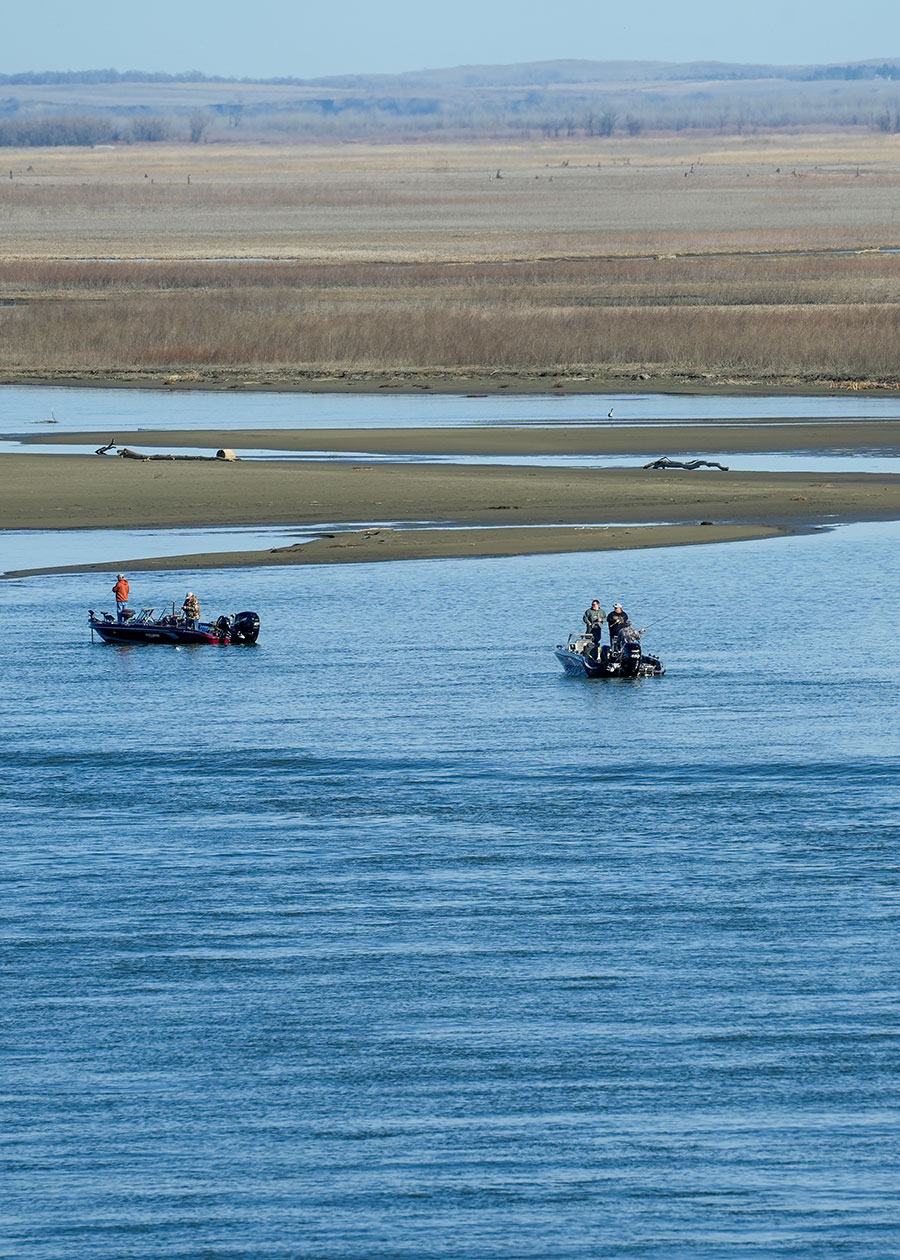
Fishing regulations are important tools that biologists can use to limit harvest to maintain the health and quality of fish populations. At the North Dakota Game and Fish Department, our philosophy is to keep fishing regulations as simple and consistent as possible for anglers by only implementing regulations that will provide a benefit to fish populations or anglers.
Length limits are designed to restrict harvest of certain sizes of fish, and come in three basic types: 1) minimum length limits prohibit harvest of fish under a specific size, 2) maximum length, or “one-over” limits restrict harvest of large fish, and 3) slot limits restrict harvest on a specific size-range of fish.
To properly assess the need for length limits, biologists examine the primary population functions that shape fish populations: reproduction or recruitment (the rate at which fish are added to a population), growth (the rate at which fish are increasing in size) and mortality (the rate at which fish are leaving a population). Would a regulation increase recruitment by protecting spawning-size fish? Are small fish abundant, or do they need protection from harvest until they reach harvestable size? Would protecting small fish result in stunting if those fish are growing slowly? Is angling harvest negatively impacting the quality of fishing or health of the fishery? Would a length limit ultimately improve fishing by increasing the numbers or size of fish caught by anglers?
These questions, and more, are considered by biologists tasked with managing the state’s fisheries. When the criteria for an effective regulation are met, it may be proposed for implemening as a new regulation. But implementing a regulation that doesn’t meet specific criteria for success may be ineffective or outright harmful to the fish population.
Referred to colloquially as the Big 3 walleye fisheries, Devils Lake, Lake Sakakawea, and the Missouri River and Lake Oahe below Garrison Dam, are the most intensively managed walleye fisheries in North Dakota. Due to their importance as angling destinations, both locally and nationally, our biologists review their data every year to determine if a length limit regulation is necessary to protect or improve walleye fishing on the Big 3. On the following pages, biologists breakdown their length limit evaluations for 2025 data.
Missouri River and Lake Oahe
Seeing good recruitment of new fish into a population is most often a welcome event by both fisheries biologists and anglers as it signals that fish should be abundant for years to come. This is especially true for the walleye population in the Missouri River and North Dakota portion of Lake Oahe where the Department relies on natural reproduction to maintain this fishery. However, excellent walleye recruitment over the last dozen or so years exemplifies too much of a good thing.
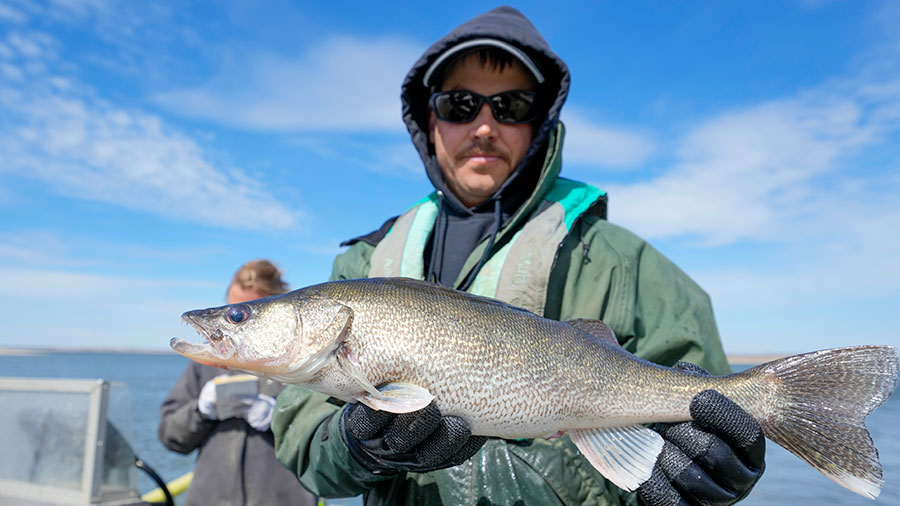
Since the Devils Lake walleye population does not meet the criteria for either a minimum or a maximum length limit, a harvest slot limit would not be appropriate either. Also, when considering a protected slot, there are a couple of necessary criteria lacking for this type of regulation to be successful at Devils Lake. The criteria not being met to see success from this type of length limit is that small fish need to have slow growth and high mortality. Small walleye in Devils Lake have adequate growth and their mortality rate isn’t particularly high. This type of regulation would work well in a situation where it’s necessary to protect moderate-sized fish while forcing anglers to mostly harvest abundant, small, slow-growing fish that are likely to die of natural causes anyway. Those conditions don’t exist on Devils Lake. The small fish can grow into the moderate-size group on their own, so forcing anglers to harvest these small fish wouldn’t be wise. Additionally, it is the moderate-sized walleye in Devils Lake that display slower growth, so protecting all of those fish from harvest may lead to a further reduction in their growth rates.
Another potential use of a protected slot limit could be to save larger fish (20- to 26-inch walleye for example) for the purposes of having more large females available to spawn. However, as previously discussed, Devils Lake walleye already exhibit the ability to reproduce successfully, so this use of a protected slot limit isn’t necessary.
We have seen that the current walleye population of Devils Lake is not really suited to any type of length limit. However, the North Dakota Game and Fish Department will continue to monitor the fishery, and if conditions change, we will consider whatever regulation is deemed necessary to protect this valuable resource.
Lake Sakakawea
Lake Sakakawea is approximately 178 miles long and covers 382,000 surface acres when full. Due to Sakakawea’s size, we often divide the lake when looking at data. Reproduction is very different from the upper portion (west end) compared to the lower portion (east end). The west end is shallower and warms up quicker in spring and we do see some natural reproduction in this part of the lake, whereas the east end is much colder and deeper with little to no natural reproduction. The lack of reproduction on the lower end is not limited by the number of adult walleye but likely due to the colder temperature that can impact egg survival and limit food for newly hatched fry.
On Lake Sakakawea, stocking of fingerlings has been used to supplement natural reproduction or the lack of natural reproduction in the middle and lower portions of the lake. A natural spawn or stocking is generally considered successful once enough of the young fish have survived and have been recruited to the adult population. At least some reproduction has been documented every year dating back to 1972 on Lake Sakakawea and more than half of the top 12 year-classes have been documented in the past 12 years.
Walleye growth on Lake Sakakawea can vary with slower growth during drought periods and good growth under normal and high lake elevations. Currently, walleye growth is considered good as they usually reach 14 inches by age 3 and 16 inches by their fourth year.
Walleye on Lake Sakakawea can live a very long time with fish up to 20 years old being documented most years. The oldest walleye documented during annual sampling was a 27-year-old fish sampled in 2018. Total annual mortality for walleye ages 3 to 15 was estimated at 35% in 2025 and is considered acceptable for maintaining the long-term sustainability of the population. Angler exploitation on Lake Sakakawea ranged from 14% to 22% during a 2019 to 2022 tagging study indicating angling mortality was low. This study also indicated walleye were more likely to die from natural causes than harvest from anglers.
Would some sort of length limit benefit Lake Sakakawea?
Lake Sakakawea has had a 14-inch minimum length limit in the past, but it currently is not needed. The lake has good reproductive success due to a combination of natural reproduction and stocking when needed. Walleye growth is good and angling mortality is low, especially on small fish. A creel survey conducted in 2024 indicated that walleye anglers do no tend to keep fish under 14 inches. Creel clerks measured 7,230 walleyes during the survey and only 334 (4.6%) were less than 14 inches.
Would Lake Sakakawea benefit from a maximum or one-over length Limit?
Recruitment on the upper portion of the lake is generally good. Recruitment in the middle and lower portions is generally limited in years when fish are not stocked and when needed, stocking has proven to be successful in augmenting the population. The poor recruitment in non-stock years is due to environmental conditions and not low numbers of large, mature fish.
A one-over 20 inches regulation is often suggested by anglers as a regulation that would benefit Lake Sakakawea. Yet both creel surveys in 2021 and 2024 showed that such a regulation would not impact the fishery. In 2021, only 4% of individual anglers harvested more than one walleye over 20 inches and only 1.8% of angler parties who had their limits of fish measured harvested more walleye over 20 inches than the number of anglers in their party. During the 2024 creel survey, 9% of individual anglers harvested more than one walleye over 20 inches and 2.9% of angler parties who had their limits of fish measured harvested more walleye over 20 inches than the number of anglers in their party. In 2021, fish over 20 inches accounted for 4% of the total harvest and in 2024, fish over 20 inches accounted for 7% of the total harvest. Currently, a maximum or one-over limit would not significantly reduce the harvest of large walleye
Finally, let’s consider slot limits. The most likely slot limits for Lake Sakakawea would be either 14-20 inches or a 15- to 20-inch harvest slot. This is what anglers on Lake Sakakawea are already doing. Data from the last two creel surveys showed that 82% of the walleye harvested in 2021 and 86% of the walleye harvested in 2024 were 14-20 inches. In 2021, 64% of the walleye harvested were 15 to 20 inches and in 2024, 81.5% of the fish harvested were from 15 to 20 inches. A harvest slot, is not necessary but is basically what most anglers are already voluntarily doing.
Considering a protected slot — such as the eater-sized fish Sakakawea anglers harvest — current angling mortality does indicate this is needed but would likely be very unpopular with anglers.
The Lake Sakakawea walleye population is monitored yearly and the information we have gathered on reproduction, recruitment, growth, and mortality indicate the current walleye fishery would not benefit from any type of length limit.