

Conservative Harvest Strategies Continue
Ron Wilson
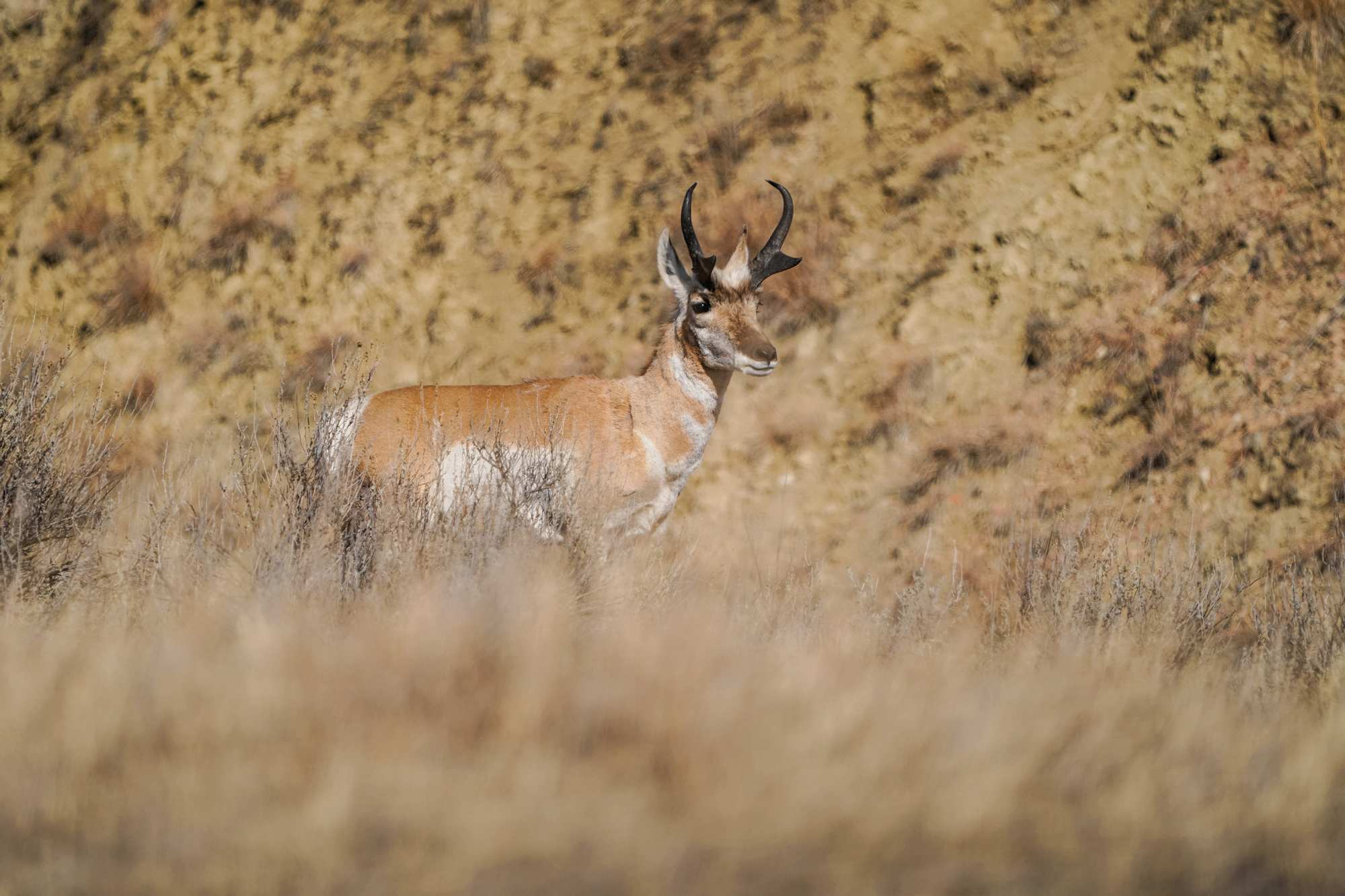
North Dakota is on the eastern edge of the pronghorn’s range, which means there is just enough suitable habitat to support a small population that can provide unique and limited opportunities for hunters most years.
That’s the reality.
“Pronghorn are a landscape scale species. They prefer large grassland ecosystems, with a lot of shrubs and forbs in the mix. They like those large expanses of wide-open country, like what you see in Montana and Wyoming where their core range is,” said Bruce Stillings, North Dakota Game and Fish Department big game management supervisor in Dickinson. “North Dakota is much more of a fragmented habitat type, and we don’t have those large expanses of grasslands and shrublands, so we’re really hamstrung by the number of pronghorn the state can support.”
Following an aerial survey from late June until early July in western North Dakota that took more than 200 hours to complete, big game biologists estimated just over 8,000 animals, and the Game and Fish Department then made available 1,310 pronghorn licenses for this fall, the same number as last year. All 18 hunting units will be open.
The statewide population increased 12% from 2025 but conservative harvest strategies continue to encourage population growth. Survey results indicated the fawn to doe ratio in 2026 was 54 fawns per 100 does, which is slightly below the long-term average of 61 fawns per 100 does. The buck to doe ratio remained stable at 31 bucks per 100 does.
“Most pronghorn hunting units will have the same number of licenses as last year,” Stillings said. “Hunting units 8A and 3B will have slightly fewer licenses where hunting units 1D and 4C will have a few more licenses, but overall, it’s going to be the exact same number of licenses as last year.”
Stillings said the annual aerial survey, which covers more than 15,000 square miles, gives biologists the most accurate perspective on how the pronghorn population is doing.
“Pronghorn are highly visible and every year you get people who say ‘Hey, I took a drive and saw 15 animals out in a hay field … I think the numbers are really good this year.’ Then on the other hand, you’ll have landowners who have been on the landscape for 30, 40 years and are seeing very few animals in their travels and say the season should be closed,” he said. “That’s why we do a complete coverage of the survey units that encompass the hunting units. We take into account the little groups of 15 scattered throughout, but then we cross those areas that are limited in pronghorn numbers or don’t have any animals at all.”
Stillings said North Dakota’s pronghorn population is in a better place than a year ago, considering the stable buck to doe ratio that will provide some limited hunting opportunities, and the bump in fawn production that, while still below the long-term average, is much better than 2025.
Even so, Stillings said the state’s pronghorn population needs a helping hand from Mother Nature in the coming months to help fuel the rebound.