NORTH DAKOTA OUTDOORS MAGAZINE
Habitat Summit 2.0
Cayla Bendel
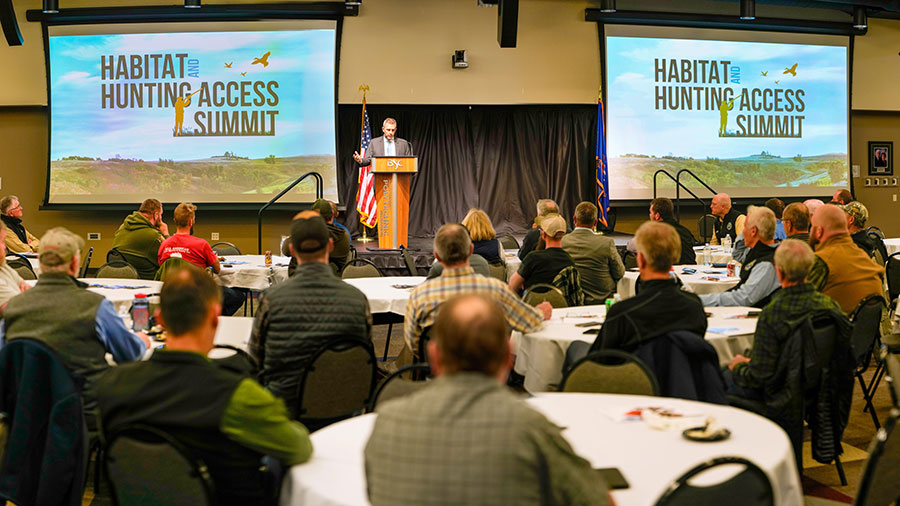
Nearly two years have passed since the North Dakota Game and Fish Department hosted the inaugural Habitat and Hunting Access Summit. Nearly 200 people gathered for the event, including then brand-new Gov. Kelly Armstrong, to set the stage of the state of our game populations, hunting access and existing pathways for conservation delivery. Throughout the evening, and afterwards through participant feedback, a list of recommendations was compiled. More importantly, the evening spurred momentum and innovation that has resulted in several wins for hunters and landowners since that 2024 gathering.
Governor’s Legacy Soil Health and Habitat Program
Much of the 2024 summit demonstrated the inarguable role the Conservation Reserve Program played in the pheasant, duck and deer heydays of the 2000s. But as successful as it is, the federally administered program lacks flexibility and current availability to North Dakota landowners.
Out of the summit, conversations led to novel partnerships that led to a $6.5 million Outdoor Heritage Fund grant to fund the Governor’s Legacy Soil Health and Habitat Program — a state run program that provides five-year agreements, annual rental payments, cost-share on grass establishment and crop insurance credits with options for hunting access payments for landowners who turn unproductive crop acres to grass.
The Soil Conservation District program was built on producer feedback, so it’s no surprise the demand for the program exceeded funding in its first year, fully obligating the OHF monies available for 10,000 acres of new grass.
The question now will be how to continue to fund the demand, but the response clearly demonstrates there was a program gap for landowners interested in habitat establishment on more flexible terms.
Leveraging Outdoor Heritage Funds
Speaking of the Outdoor Heritage Fund, the Legacy program was just one of many wins for hunters and habitat enthusiasts in the 2026 grant rounds. OHF was established in 2013 to provide monies from state oil and gas revenue for projects that provide access to sportsmen, improve soil health, water quality and plant health, or provide natural areas for recreation such as parks.
The grant has long been a tool for conservation delivery used by Game and Fish and other partners, but 2026 saw a number of funded grants bolstered by conversations and solutions from the 2024 Habitat Summit. Pheasants Forever’s Public Access to Habitat program provides new or existing Private Land Open To Sportsmen cooperators an additive payment for establishing new grass, Ducks Unlimited’s Wetland Access and Restoration Program similarly funds wetland enhancement projects on PLOTS lands, and Game and Fish applied to leverage sportsmen voluntary donation dollars with OHF monies to multiply funds available for PLOTS agreements.
These are just a few examples of how partners have recently worked to maximize the OHF for collaborative habitat and access initiatives.
New Hunter Landowner Communication Tools
At the end of the day, access comes down to hunters communicating with landowners, and the Department continues to work on ways to facilitate that, especially in an increasingly digital world. This year we have just under 15 million acres of electronically posted land. But within that posting system, there is still room for communication, as 43% of landowners voluntarily provided a form of contact information. And new in 2026, about 180,000 acres were enrolled in one of the other posting date options, of either being posted only during the deer rifle season (Nov. 6-22) or being posted through the deer rifle season (July 1-Nov. 22). While that’s only about 1% of e-posted lands, it’s still a meaningful amount of additive access. Contact information and unique posting types can be found in the parcel information on mapping applications.
Additionally, the Department continues to grow and promote Hunt Link. This resource was rolled out at the end of 2025 and provides a species-specific map of landowners who have expressed interest in wanting hunters for either depredation issues or interest in providing youth deer access. At any time, landowners can go in and remove their listing if their needs have been met or they no longer want to be contacted. The application replaces the once manual processes connecting the two but also has the potential to expand to other species-specific landowner requests.
Habitat and Access Stakeholder Group
With a mission to increase transparency, understanding and communication regarding Department habitat and conservation programs and hunting access initiatives on private lands, the Habitat and Access Stakeholder Group was formed in 2026. This group is made up of six representatives, three hunters and three landowners, from four districts nominated by the Department. The group serves as a sounding board for many of the initiatives and those forthcoming, while providing a valuable pulse on regional challenges and opportunities for improved hunter-landowner relations.
We’ve made progress. Now, let’s build on it. That’s the theme for the 2026 Habitat and Hunting Access Summit which will be held on Dec. 15, once again at the Bismarck State College National Energy Center of Excellence. The evening will highlight what’s been done since we last gathered but also continue to focus on collaborative solutions for expanding habitat and improving access in North Dakota. Some of which participants may have the opportunity to shape in the upcoming North Dakota legislative session. Space is limited and the public can register on the Game and Fish website, gf.nd.gov.
While I acknowledge there’s a lot of work to be done, I hope you have found plenty to enjoy this fall. The Department isn’t responsible for allocating the number of deer camp invitations, golden hour walks with your dog or first birds you help someone harvest. There’s still plenty to be grateful for, especially on any given North Dakota November day. Go enjoy it, and I’ll see you in December to talk about how to keep it that way.