

Deertoe

Valley City State University
The smallest mussel in North Dakota, the Deertoe has a triangular shaped shell with a rounded anterior and bluntly pointed posterior. Their color is variable, ranging from yellow-green to dark brown with green rays present of varying widths.
Status in North Dakota
Year-round resident but rare in abundance.
Range Map

Deertoe range in North Dakota.
Reason for SWAP Designation
This species is regionally at risk or declining and North Dakota represents an important portion of its range.
Changes in land use in/around rivers including agriculture and impoundments have impacted this species, specifically related to their beds.
Threats
Impoundments of the James River has altered the flow regime creating unsuitable habitat for the Deertoe by increasing sediment deposition and blocking host fish movement.
Agricultural practices, wetland drainage, and other land use practices continue to degrade water quality.
Research and Monitoring
A monitoring protocol for mussels has been developed by the North Dakota Game and Fish Department (NDGF) under the State Wildlife Grant Program with increased implementation as a future goal.
Additionally, the North Dakota Department of Environmental Quality (NDDEQ) conducts biological monitoring surveys on State waters as part of their Index of Biotic Integrity (IBI) development.
Valley City State University (VCSU) conducted a two-phase populations survey of mussels in 2008-2010 and began another evaluation in 2024.
Management Recommendations
- Develop/maintain buffers along riparian areas.
- Partner with local, state, and federal entities to limit chemical use in/near aquatic habitats.
- Continue partnering with local, state, and federal entities to maintain instream flows.
- Continue partnering with local, state, and federal entities to reduce wetland drainage.
- Remove river impoundments where possible.
- Encourage efficient use of pesticides.
Primary Geological Regions

Habitat Associations
Habitat Use
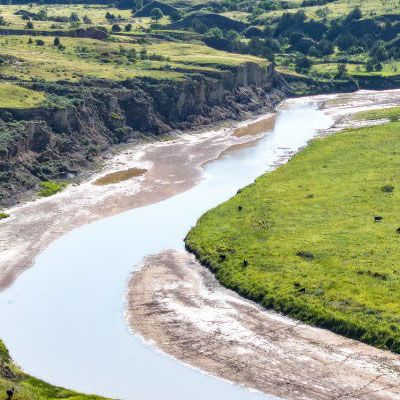
The Deertoe can be found in medium to large rivers with gravel, mud, or sand substrate.
In North Dakota, the Deertoe is currently only found in the James River.