
Plains Emerald

Valley City State University
A dragonfly and member of the family Corduliidae. Larval stage has 5 short appendages on posterior, two pairs of wing pads, large eyes, and mouthparts in the shape of a spoon. Keying to the species level based on larval stage is very difficult. Larval stage present throughout the open water season but most abundant through July-August when they typically emerge into the adult stage.
Status in North Dakota
Year-round resident of North Dakota waterbodies as larvae.
Larval stage can last 2-4 years with the adult stage typically lasting around one month.
Range Map

Somatochlora ensigera potential range in North Dakota.
Reason for SWAP Designation
A regional species of concern with limited data in North Dakota and an at-risk species based on expert review (SGCN c).
This species has a spotty distribution across North Dakota with documented adults in Adams, Grand Forks, Lamoure, Logan, Sheridan, Stark and Walsh counties but could likely be present throughout the state.
Threats
Limited habitat availability, land development, climate change, sedimentation, energy development and agricultural practices.
Research and Monitoring
Limited research has been conducted.
The North Dakota Department of Environmental Quality (NDDEQ) conducts biological monitoring surveys on State waters as part of their Index of Biotic Integrity (IBI) development.
Additionally, a monitoring protocol for aquatic invertebrates is being developed by the North Dakota Game and Fish Department (NDGF) under the State Wildlife Grant Program with implementation as a future goal.
Additionally, a survey of aquatic invertebrates in cooperation with Valley City State University is currently underway to gain additional baseline information on SGCN’s.
Management Recommendations
- Protect and conserve large, intact tracks of native/unbroken forested areas.
- Develop/maintain buffers along riparian areas.
- Partner with local, state, and federal entities to limit chemical use in/near aquatic habitats.
- Partner with local, state, and federal entities to remove dams where logically feasible.
- Encourage efficient use of pesticides.
Primary Geological Regions

Habitat Associations
Habitat Use
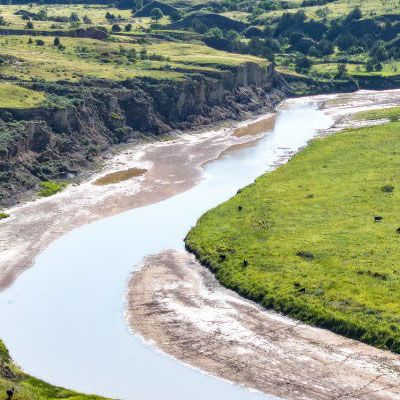
Occurs in small rivers and streams with well defined, forested riparian zones such as the Tongue River and North Branch Park River.