


Buffaloberry Patch
CWD Testing, Disposal Requirements
The North Dakota Game and Fish Department will continue its hunter-harvested surveillance program during the 2026 hunting season by sampling deer for chronic wasting disease from select units in the southwestern portion of the state.
Samples will be tested from deer taken from units 2J1, 3B3, 3C, 3D1, 3D2, 3E1, 3E2, 3F1, 3F2, 4D, 4E and 4F. Outside of this area, hunters can still have their animal tested by taking to a Game and Fish district office, deer head collection site or by using a self-sampling kit.
CWD is a slow-moving brain disease of deer, moose and elk that can cause population-level impacts under high infection rates.
Hunters are encouraged to drop off heads of adult or yearling deer at collection locations. Fawns and head-shot deer cannot be tested. Hunters wishing to keep the heads can bring them to a Game and Fish district office during business hours to have them sampled.
Self-sampling kits are available for hunters who wish to have their deer tested but are unable to drop the head at a collection site. The do-it-yourself kit allows hunters to remove the lymph nodes and ship them to the Department’s wildlife health lab for testing. The kits can be found on the Department’s website and at district offices.
Results can be expected within four weeks and will be sent to your Game and Fish My Account inbox.
Hunters are also reminded that carcass disposal requirements apply statewide. The entire carcass can be transported outside of the gun unit where it was harvested. If transported out of the gun unit, the carcass waste (material left after processing) must be disposed of via landfill or waste management provider. This requirement does not apply to heads dropped at CWD collection sites, or lymph nodes submitted for CWD surveillance.
More information on CWD is available on the Game and Fish website.
Zebra Mussels Found in Sakakawea
After detecting zebra mussel larvae in routine sampling, the North Dakota Game and Fish Department has confirmed the presence of invasive zebra mussels on the extreme eastern portion of Lake Sakakawea.
Ben Holen, Department aquatic nuisance species coordinator said, “Follow-up sampling found two adult mussels along the northern shoreline near the Highway 83 Embankment.”
While current findings suggest the infestation is isolated to the far eastern stretch of the reservoir, Game and Fish personnel, working with the U.S. Army Corps of Engineers, will conduct expanded surveys in the coming days to delineate the infested area.
Officials note that falling water temperatures this fall greatly reduce the immediate risk of zebra mussel spread. The Department will work with stakeholders over the winter to refine appropriate rules and implement best management practices to mitigate the spread of mussels before next year’s boating season.
For more information on aquatic nuisance species, or to report a suspected sighting, visit gf.nd.gov/ans.
Preparing for Access Challenges on the MRS in 2027
Ongoing low water conditions across Lake Sakakawea, Lake Oahe and the Missouri River are projected to cause significant boating access challenges throughout the 2027 season. With further water level reductions anticipated, state and federal agencies are proactively preparing for less-than-optimal conditions at many popular recreation sites.
North Dakota Game and Fish Department, North Dakota Parks and Recreation Department, U.S. Army Corps of Engineers, and local partners are actively collaborating to address boating access needs immediately following ice-out in early 2027. However, officials caution boaters and anglers that, despite this work, many boat ramps and parking lots will be less than ideal.
To manage the anticipated congestion at viable ramp locations, the Game and Fish Department is implementing adjustments to the 2027 Missouri River System fishing tournament schedule.
No additional open water fishing tournaments will be permitted beyond those already approved during the 2026 scheduling cycle.
Water recreationists are encouraged to plan ahead and monitor official updates as the 2027 boating season approaches.
Complete the Survey
North Dakota hunters receiving a survey this winter are encouraged to help with wildlife management by completing the survey online or returning it to the state Game and Fish Department.
Big game, small game, waterfowl, swan, turkey and furbearer questionnaires will be mailed to randomly selected hunters.
Hunters should complete and promptly return the survey, even if they did not hunt. The harvest survey allows Game and Fish to evaluate the hunting season, to determine the number of hunters, amount of hunting activity and size of the harvest.
A follow-up survey will be mailed to those not responding to the first survey.
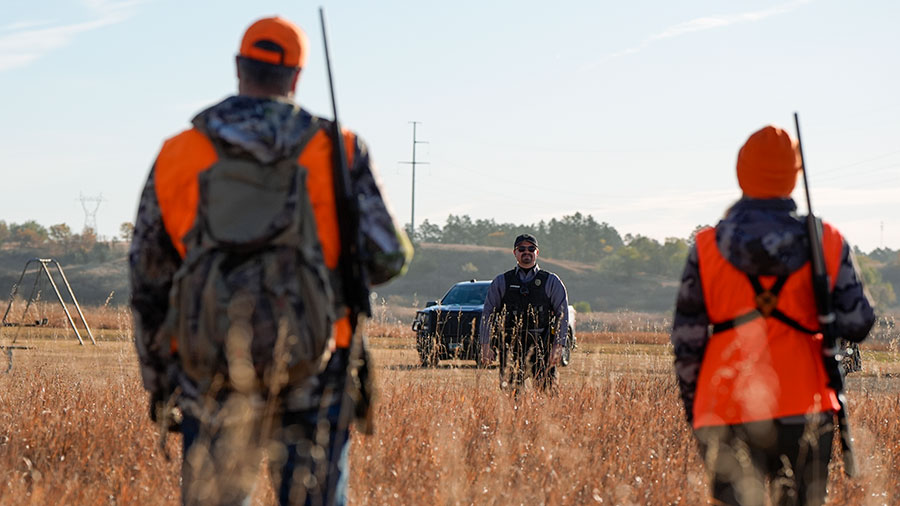
Make the Call
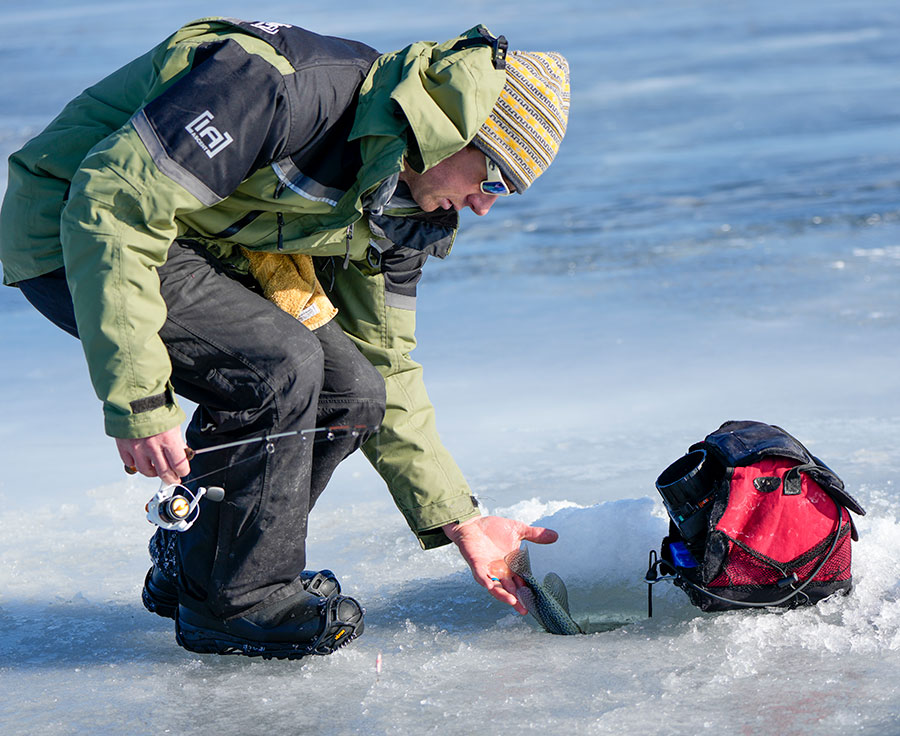
Ice Fishing Regulations
No Registration Required
North Dakota’s darkhouse spearfishing season opens whenever ice-up occurs. The season extends through March 15. Legal fish are northern pike and nongame species.
In addition, for Stump Lake and the Devils Lake complex south of U.S. Highway 2 and the Missouri River System (including lakes Sakakawea, Oahe and the Missouri River) up to the first tributary bridge, walleyes are also legal.
Darkhouse spearing is allowed for all anglers with a valid fishing license and for youth under age 16.
Individuals are required to possess the valid fishing license needed to participate in darkhouse spearfishing. But, unlike seasons past, participants do not need to register with the North Dakota Game and Fish Department prior to participating.
All waters open to hook and line fishing are open to darkhouse spearing except: Lake Audubon, East Park Lake and West Park Lake, all McLean County; Heckers Lake, Sheridan County; Larimore Dam, Grand Forks County; McClusky Canal; New Johns Lake, Burleigh County; Red Willow Lake, Griggs County; Wood Lake, Benson County; Lake Ashtabula, Barnes and Griggs counties; and Whitman Dam, Nelson County.
Anglers should refer to the 2024-26 North Dakota Fishing Guide for more information.
Order 2027 NDO Calendar
The North Dakota Game and Fish Department is taking orders for its North Dakota OUTDOORS calendar, the source for all hunting season and application dates for 2027. Along with color photographs of North Dakota’s wildlife and outstanding scenery, it also includes sunrise-sunset times and moon phases.
Calendars must be ordered online.
The calendar is the North Dakota OUTDOORS magazine’s December issue, so current subscribers will automatically receive it in the mail.
Historical Look at Waterfowl in North Dakota
The storied past of waterfowl in North Dakota is uniquely revealed in the North Dakota Game and Fish Department’s publication, “The Duck Factory – A History of Waterfowl in North Dakota.”
Certainly of interest to waterfowlers and other outdoor enthusiasts, the 213-page, full color, soft-cover publication is authored by Mike Jacobs and Erik Fritzell. The book traces the history of waterfowl species and their habitats in North Dakota.
The book is sold only online for $24.99, including shipping.
Staff Notes

Fisheries Chief Retires
Greg Power retired in November after more than 40 years with the North Dakota Game and Fish Department.
Power’s employment with the agency started in 1979 as a seasonal aide in Riverdale and he became a full-time fisheries research biologist in 1986. A University of North Dakota graduate, Power was appointed chief of fisheries in 2006, a position he held until his retirement.

Halstead Retires
Dan Halstead retired earlier this fall after 28 years with the North Dakota Game and Fish Department.
At the time of his retirement, Halstead was the wildlife resource management supervisor in Riverdale, a position he held for the length of his career with the agency.
“Dan has made lasting contributions to the Department and wildlife conservation,” said Bill Haase, Department wildlife division chief. “His extensive knowledge, years of experience and unwavering commitment to wildlife management have made a meaningful difference and will benefit the Department for years to come.”

Oster Named Section Leader
Jake Oster was named wildlife resource management section leader for the North Dakota Game and Fish Department.
Oster started working for the agency in 2013. Before his promotion, Oster worked as a wildlife resource management biologist in Riverdale.

Bandy Joins Agency
Logan Bandy has filled the Game and Fish Department’s private lands biologist position in Williston.
Bandy has a Bachelor of Science in wildlife and fisheries resources from West Virginia University He worked for the Department as a seasonal employee in Riverdale and Williston beginning in 2024.
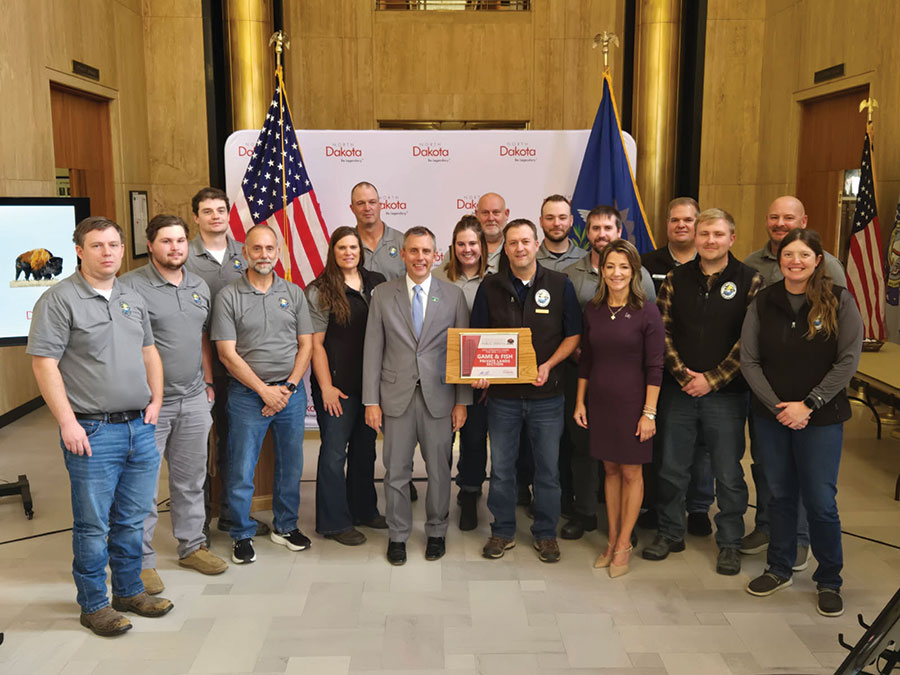
PLI Team Lands Governor’s Award
The North Dakota Game and Fish Department’s private lands initiative team was awarded the Strength from the Soil Award at the 2026 Governor’s Awards for Excellence in Public Service in September.
The PLI team was recognized for their efforts through innovation, partnership, and a commitment to keeping North Dakota’s agricultural and natural landscapes productive, resilient, and healthy for generations to come.
While the team is responsible for the nationally recognized Private Land Opens To Sportsmen program, their impact extends beyond acres on a map. The PLI team has demonstrated that conservation and agriculture are not competing priorities. By listening to landowners, building partnerships and developing innovative programs, they have created a model in which healthy soils, productive working lands, abundant wildlife and public access reinforce one another.