

State Wildlife Action Plan - Climate Adaptation Case Studies
Case Study 1: How will climate and land use change affect butterflies in the state of North Dakota?
Butterfly populations are experiencing declines across the globe, with land use practices and climate change emerging as important contributors to those trends1-2. Land use and climate change likely interact to influence butterfly abundance and distribution, with the relative strengths of these two stressors varying by geography and by species3-5. Future projections of climate and land use change effects on butterflies are also subject to various uncertainties. Coping with uncertainty about the future is a difficult task for scientists and managers alike. To address uncertainties when considering climate change, it may be especially useful to craft multiple divergent scenarios to explore what plausible futures might look like and then design management strategies around those scenarios.
This case study focuses on two grassland butterfly species regarded as Species of Greatest Conservation Need by North Dakota Game and Fish: the regal fritillary (Speyeria idalia) and Dakota skipper (Hesperia dacotae). We highlight the potential effects of climate change on these species and discuss scenario-based approaches to understanding and addressing potential effects.
Effects of climate change on the distribution of Dakota skippers
Recent work in the Northern Great Plains has shown that Dakota skipper abundance in North Dakota is driven by both land use and climate fluctuations7-9. Barnes et al. (9) specifically modeled the influence of climate conditions on Dakota skipper habitat use. Their modeling efforts allowed them to map future distributions of the species under different climate change scenarios (Figure 1). Their analysis showed that by the year 2100, most of the suitable habitat for Dakota skipper in the Northern Great Plains, including North Dakota, will be lost and shifted further north (Figure 1C). To incorporate uncertainty in the findings, this mapping exercise looked at where the multiple scenarios of future Dakota skipper distributions (based on current climate associations of the species) were in agreement. Figure 1 shows that the regions where suitable climate conditions may exist in the future are mainly in central Canada.
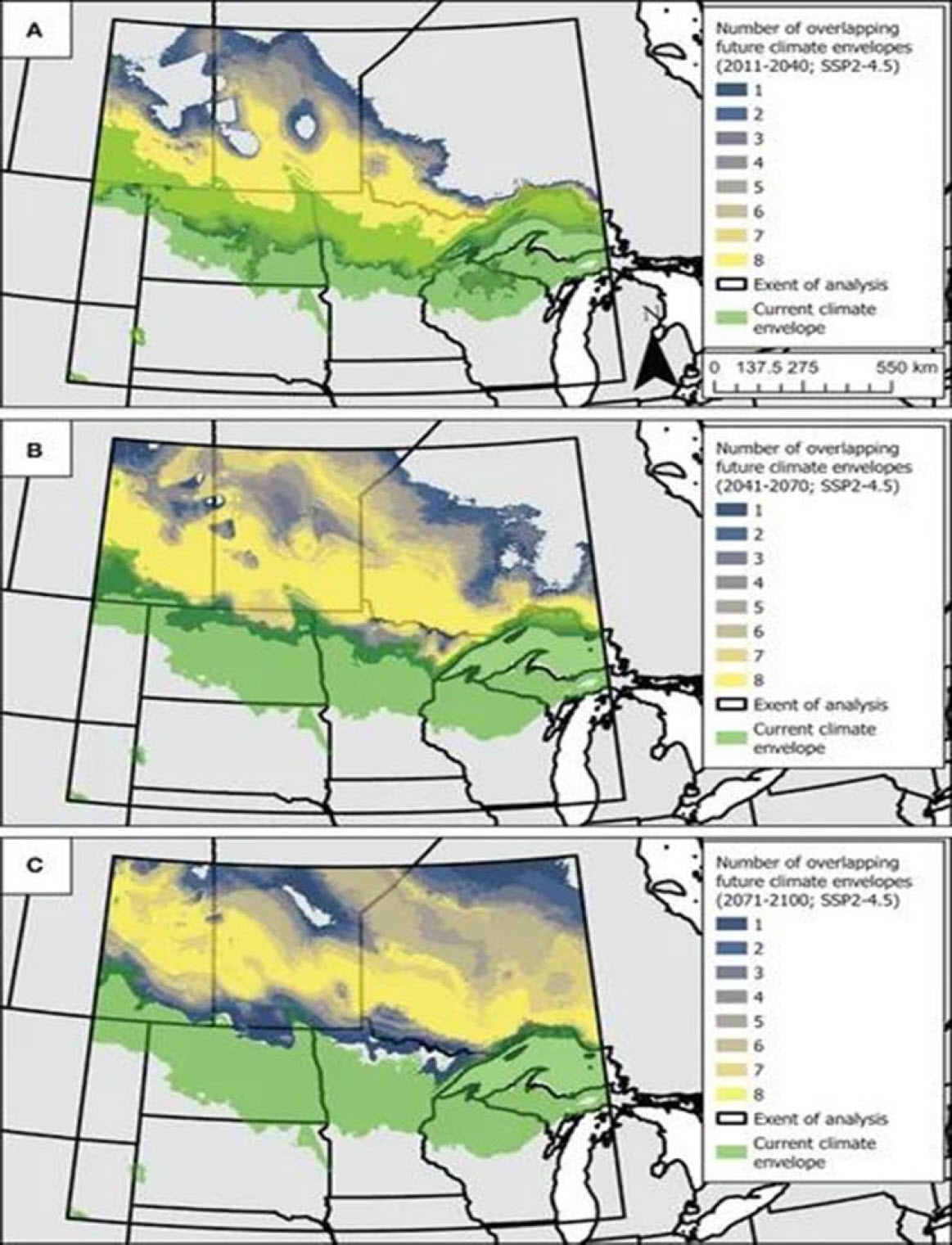
Figure 1. Reproduced from Barnes et al. (9). This figure shows the climate envelopes for 8 different climate models. Climate envelopes were defined as the range of bioclimatic conditions that were associated with suitable Dakota skipper habitat. The green polygons show where suitable bioclimatic conditions occur assuming current conditions. The numbers in the legend represent the number of climate models that forecasted suitable conditions in the future. Yellow regions, for example, show the most overlap in suitable conditions in the future, indicating more confidence in which changes have a higher possibility of occurring. Each panel represents a different period: 2011-2040 (A), 2041-2070 (B), and 2071-2100 (C). These panels were created assuming a SSP2-4.5 warming scenario, which is regarded as a middle-of-the-road scenario in terms of warming.
Effects of climate change on the distribution of regal fritillaries
Post van der Burg et al. (10) found that habitat use by regal fritillaries was controlled by the availability of grassland habitat and spring weather conditions. Therefore, under a moderate warming scenario, regal fritillary distributions would be expected to shift northward, resulting in a potential increase in habitat use in North Dakota’s Prairie Pothole Region10-11 (Figure 2B). This potential positive effect on the regal fritillary in the region is persistent even if considered across multiple land use scenarios where agriculturally intensive land use futures reduced the amount of available habitat. However, when considering more extreme climate warming scenarios, the habitat use of this butterfly is projected to steeply decline (Figure 2C).
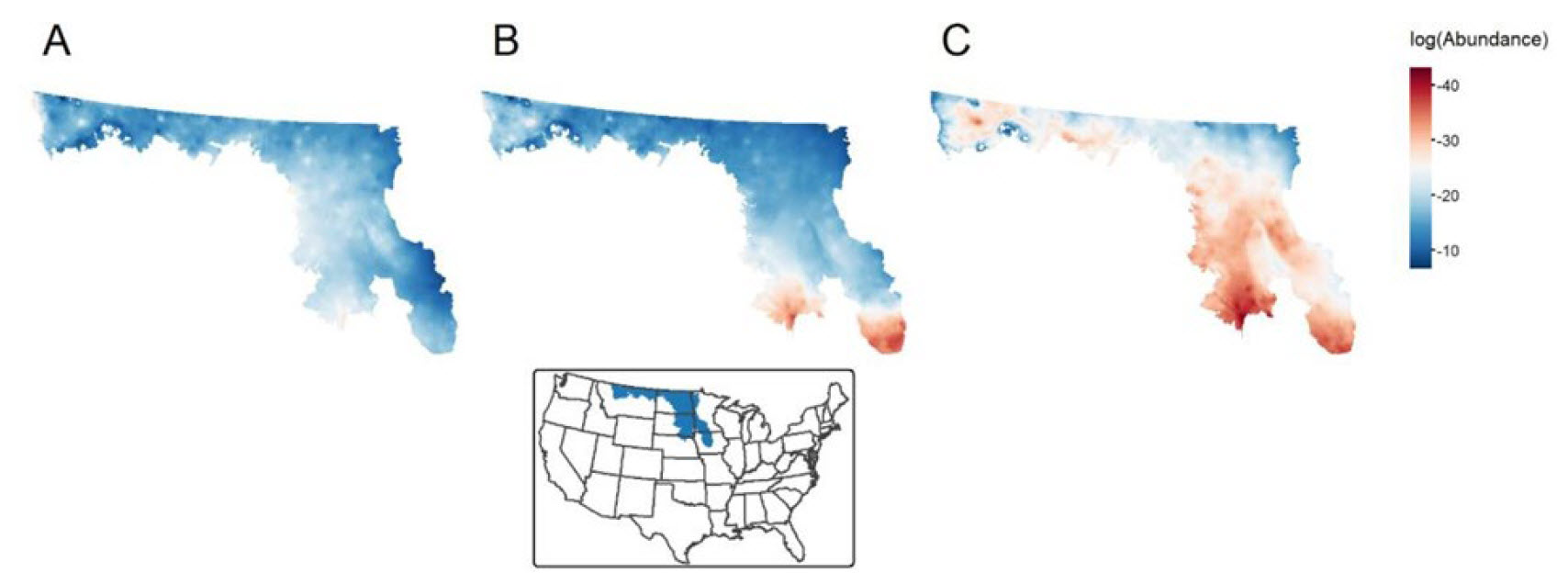
Figure 2. Figure reproduced from the Post van der Burg (1). These maps show predicted regal fritillary habitat use (as abundance of use points) of pixels in the Prairie Pothole Region of the U.S. on the natural log scale. Regions in blue show higher use values and regions in red show lower use values. Panel A shows habitat use under current climate conditions; Panel B shows habitat use under moderate warming (Representative Concentration Pathway 4.5) in year 2100; and panel C shows habitat use under severe warming (Representative Concentration Pathway 8.5) in year 2100. Inset shows the location of the Prairie Pothole Region in the U.S.
What do these analyses teach us about how to address uncertainty and develop potential management strategies?
The analyses by Barnes et al (9) and Post van der Burg et al. (11) provide insights into how uncertainty can be harnessed to inform managers about potential futures. When used within a formal decision-making framework, scenarios can help to assess how different management or conservation strategies, such as landscape-level planning, may perform under different conditions6. But such analyses may also be useful in more informal ways. For example, scenario thinking could be used by managers to explore best- and worst-case futures and develop plans for how to respond to those futures. Scenarios may also allow managers to think preemptively about how to avoid unintended consequences and strategize about which metrics need to be monitored in order to anticipate possible changes. Lastly, use of scenarios can be of assistance in making triage types of decisions. Our butterfly case studies suggest that local populations of two butterfly species in North Dakota could possibly disappear over time as the climate changes. Although grassland management will continue to be crucial for many species in the future, the specific species prioritized in the State Wildlife Action Plan may shift depending on the direction and magnitude of climate change. Thus, planning for which new species might be added as priorities to the SWAP would be an additional potential use of a scenario-based approach.
Case Study 1 References:
- Crossley M. S., Smith O. M., Berry L. L., Phillips-Cosio R., Glassberg J., Holman K. M., Holmquest, J.G., Meier, A.R., Varriano, S.A., McClung, M.R., Moran, M.D., Snyder, W.E. 2021. Recent climate change is creating hotspots of butterfly increase and decline across North America. Global Change Biology 27, 2702–2714. DOI: 10.1111/gcb.15582
- Warren, M.S., Maes, D., van Swaay, C.A., Goffart, P., Dyck, H.V., Bourn, N.A., Wynhoff, I., Hoare, D., Ellis, S. 2021. The decline of butterflies in Europe: Problems, significance, and possible solutions. Proceedings of the National Academy of Sciences 118, e2002551117. DOI: 10.1073/pnas.2002551117
- Diengdoh V.L., Ondei S., Amin R. J., Hunt M., Brook B.W. 2023. Landscape functional connectivity for butterflies under different scenarios of land-use, land-cover, and climate change in Australia. Biological Conservation 277, 109825. DOI: 10.1016/j.biocon.2022.109825
- Schweiger, O., Settele, J., Kudrna, O., Klotz, S., Kühn, I. 2008. Climate change can cause spatial mismatch of trophically interacting species. Ecology 89, 3472–3479. DOI: 10.1890/07- 1748.1
- Vermaat, J., Hellmann, F., Teeffelen, A., Minnen, J., Alkemade, R., Billeter, R., Beierkuhnlein, C., Boitani, L., Cabeza, M., Feld, C.K., Huntley, B., Paterson, J., WallisDeVries, M.F. 2017. Differentiating the effects of climate and land use change on European biodiversity: A scenario analysis. Ambio 46, 277–290. DOI: 10.1007/s13280-016-0840-3
- Miller, B.W., Eaton, M.J., Symstad, A.J., Schuurman, G.W., Rangwala, I., Travis, W.R. 2023. Scenario-Based Decision Analysis: Integrated scenario planning and structured decision making for resource management under climate change. Biological Conservation 286, 110275. DOI: 10.1016/j.biocon.2023.110275
- Post van der Burg, M., Austin, J.E., Wiltermuth, M.T., Newton, W., MacDonald, G. 2020. Capturing spatiotemporal patterns in presence-absence data to inform monitoring and sampling designs for the threatened Dakota skipper (Lepidoptera: Hesperiidae) in the Great Plains of the United States. Environmental Entomology 49, 1252–1261. DOI: 10.1093/ee/nvaa081
- Post van der Burg, M., Symstad A.J., Igl L.D., Mushet D.M., Larson D.L., Sargeant G.A., Harper, D.D., Farag, A.M., Tangen, B.A., Anteau, M.J. 2022. Potential effects of energy development on environmental resources of the Williston Basin in Montana, North Dakota, and South Dakota—Species of conservation concern in U.S. Geological Survey Scientific Investigations Report 2017–5070–D., Reston, VA: United States Geological Survey, 41. DOI: 10.3133/sir20175070D
- Barnes KW, Toso LB and Niemuth ND (2024) Dakota skipper distribution model for North Dakota, South Dakota, and Minnesota aids conservation planning under changing climate scenarios. Front. Ecol. Evol. 12:1304748. doi: 10.3389/fevo.2024.1304748
- Post van der Burg, M., MacDonald, G., Hefley, T., Glassberg, J. 2023. Point-scale habitat and weather patterns influence the distribution of regal fritillaries in the central United States. Ecosphere 14, e4429. DOI: 10.1002/ecs2.4429
- Post van der Burg, M., 2025. Measuring butterfly persistence in the face of deep uncertainty: a case study using the regal fritillary. Frontiers in Ecology and Evolution 12, 1482783. DOI: 10.3389/fevo.2024.1482783
Case Study 2: Managing Invasive Grasses in Native Temperate Prairies
Land conversion continues to reduce the already greatly diminished extent of grassland in North Dakota and other Great Plains states1. Grassland ecosystems, which support sensitive wildlife including Dakota skipper (Hesperia dacotae), Sprague’s pipit (Anthus spragueii), and plains hog-nosed snake (Heterodon nasicus), are also being reshaped by the extensive spread of invasive plant species2. Repeated prescribed fire is a crucial management tool for controlling invasive vegetation, such as smooth brome (Bromus inermis Leyss.) and Kentucky bluegrass (Poa pratensis L.), in North Dakota grasslands3. By strategically burning at times of the year when cool-season invasives are growing and warm-season natives are largely dormant, prescribed fire can reduce existing invasions or prevent new incursions4. The effectiveness of this management tool can be sensitive to the vegetation composition, seasonal variability, and antecedent conditions4; changing climate conditions may further modify the effectiveness and use of this approach:
- Action Effectiveness: Warming climate brings earlier springs and, when moisture is sufficient, extends plant growth later into the fall5; plant and animal adjustments to these changes are species-specific and not always predictable6. If active growth periods of natives and invasives become more overlapping, prescribed fire will become less effective (Figure 1B). In contrast, if growth periods become more separated, prescribed fire’s effectiveness for controlling invasives would presumably increase (Figure 1C). However, species-specific shifts in wildlife phenology may also complicate the use of prescribed fire; for example fire is often avoided during vulnerable parts of the breeding season for some ground nesting birds7. Moreover, warming climate may bring new invasive species with growth patterns that overlap natives’ to the region8,9 (Figure 1D).
- Logistics and Social Support: Warming temperature and changing seasonality may limit the times when prescribed fire can be implemented safely, making this management tool more logistically challenging10. Disconnect between the windows when prescribed fire is allowed and feasible and when fire is most effective will also likely limit use7. There are already negative perceptions concerning fire in the region11, which may be exacerbated by increasing fire potential overall in the region5, resulting in prescribed fire being a less socially feasible management option.
How might management adapt to these changes?
- Future research is needed to examine how the timing of phenological events for invasive grasses, native grasses, and wildlife will coincide with current and future windows of feasible prescribed fire. If prescribed fire is no longer a feasible option in the future, other actions such as targeted grazing or haying may need to be considered.
- Rigid prescriptions of management may not meet management goals in a changing climate10. Instead, management plans that accommodate shifting prescribed fire seasons may be more effective. Further, adjusting seasons or timing of fire may require changes to funding and hiring cycles to allow for more flexible resources.
- With the uncertainty inherent in the changing climate and species’ responses, it is crucial to evaluate the effectiveness of both current and new management approaches. Adaptive management approaches, such as the Native Prairie Adaptive Management program12, incorporates rigorous monitoring, modeling, and feedbacks between model output and future management actions to determine the most effective management approach.
- Early detection of and rapid response to new invasives may reduce future management challenges8.
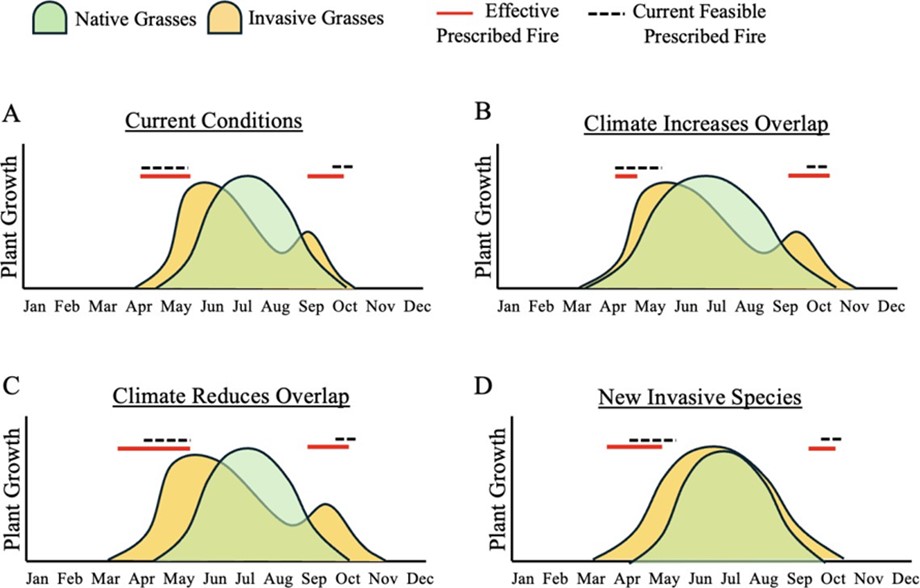
Figure 1. Changing climate conditions will alter the time of the year at which prescribed fire is both feasible and effective. In current conditions (A) prescribed fire can be both effective and feasible in the early spring and mid-fall. If climate change increases the phenological overlap between native and invasive grasses (B), the time window for effective prescribed fire will be reduced. If climate change reduces the phenological overlap between native and invasive grasses (C), the time window for effective fire will be increased relative to current conditions. A new invasive species, such as a warm-season grass shown here, could also change the seasonal effectiveness of prescribed fire for promoting native vegetation (D). For simplicity, the window of time for effective prescribed fire (red solid line) shifts across these four scenarios but the time window for current feasible fire (black dashed line) does not vary. However, in North Dakota the number of days for conducting prescribed fire has decreased in the spring and increased in the early fall since the 2000s.10. Figures are conceptual; they do not depict quantitative values.
Case Study 2 References:
- Wimberly, M. C. et al. Cropland expansion and grassland loss in the eastern Dakotas: New insights from a farm-level survey. Land Use Policy 63, 160–173 (2017).
- Palit, R., Gramig, G. & DeKeyser, E. S. Kentucky Bluegrass Invasion in the Northern Great Plains and Prospective Management Approaches to Mitigate Its Spread. Plants 10, 817 (2021).
- Kobiela, B., Quast, J., Dixon, C. & DeKeyser, E. S. Targeting Introduced Species to Improve Plant Community Composition on USFWS-Managed Prairie Remnants. Natural Areas Journal 37, 150–160 (2017).
- Ratcliffe, H. et al. Invasive species do not exploit early growing seasons in burned tallgrass prairies. Ecological Applications 32, e2641 (2022).
- Knapp, C. N. et al. Chapter 25 : Northern Great Plains. Fifth National Climate Assessment. https://nca2023.globalchange.gov/chapter/25 (2023) doi:10.7930/NCA5.2023.CH25.
- Dunnell, K. L. & Travers, S. E. Shifts in the flowering phenology of the northern Great Plains: Patterns over 100 years. American J of Botany 98, 935–945 (2011).
- Clark, A. S. et al. Barriers to Prescribed Fire in the US Great Plains, Part I: Systematic Review of Socio-Ecological Research. Land 11, 1521 (2022).
- Gaskin, J. F. et al. Managing invasive plants on Great Plains grasslands: A discussion of current challenges. Rangeland Ecology & Management 78, 235–249 (2021).
- Perkins, L. B., Ahlering, M. & Larson, D. L. Looking to the future: key points for sustainable management of northern Great Plains grasslands. Restoration Ecology 27, 1212–1219 (2019).
- Yurkonis, K. A., Dillon, J., McGranahan, D. A., Toledo, D. & Goodwin, B. J. Seasonality of prescribed fire weather windows and predicted fire behavior in the northern Great Plains, USA. fire ecol 15, 7 (2019).
- Bendel, C., Toledo, D., Hovick, T. & McGranahan, D. Using Behavioral Change Models to Understand Private Landowner Perceptions of Prescribed Fire in North Dakota. Rangeland Ecology & Management 73, 194–200 (2020).
- Gannon, J. J., Grant, T. A., Vacek, S. C., Dixon, C. S. & Moore, C. T. Crisis on the Prairies Revisited: Implementation of the Native Prairie Adaptive Management Program. Ecological Rest. 42, 64–76 (2024).
Case Study 3: Climate and land use changes are turning wetlands into large lakes, with consequences for ducks and North Dakota infrastructure
Wetlands in North Dakota occur on continuums of both size and hydroperiod, or the duration they hold water, ranging from small temporary wetlands to large permanent wetlands (Figure 1). Changes in land use practices, climate, and weather are shifting the size and hydroperiod of some wetlands. These changes may have large effects on wildlife dependent on wetland habitat, including ducks.
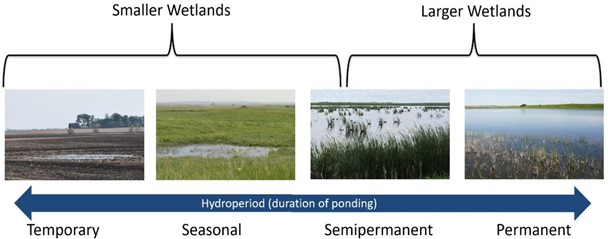
Figure 1. Examples of wetlands of North Dakota arranged on a continuum of hydroperiod (duration it holds water) and general size. Photographs by the U.S. Geological Survey.
Not all wetlands are changing the same way. Most temporary and seasonal wetlands that are unmodified by direct drainage have maintained similar hydroperiods through time, i.e., they typically still dry up annually1-3. However, larger semipermanent and permanent wetlands are transitioning into larger and more interconnected lakes4-6. These historically semipermanent wetlands that have shifted to lakes are generally not being replaced by shifts in smaller wetlands, resulting in losses to this important wetland class. Both changes in climate and land use, as well as their interactive effects, appear to be contributing to this loss of semipermanent wetlands.
Climate Drivers: The climate has shifted to a wetter period in North Dakota, evident since the early 1990s7. This wetter period has resulted in more surface water runoff into wetlands. Precipitation patterns are also shifting to more intense rainfall events during the summer8; intense rainfall contributes more to runoff than less intense events. As wetlands fill in response to increased precipitation, larger wetland basins are disproportionately influenced relative to smaller wetland basins.
Land-use Drivers: There has been an increase in tilled agricultural landcover throughout North Dakota9, and tilled agricultural land generates greater precipitation runoff than grasslands10-12. Additionally, consolidation drainage, the practice of draining smaller wetlands into larger wetlands has driven increases in the water levels and extent of semipermanent and permanent wetlands in North Dakota4,5.
Additive and interacting factors: Increasing magnitude and intensity of rainfall, runoff on agricultural land, and consolidation drainage all combine to have profound additive and perhaps synergistic effects that accelerate the conversion of semipermanent and permanent wetlands into large lakes that eventually have stable water levels and are often interconnected with other waterbodies5,6,13.
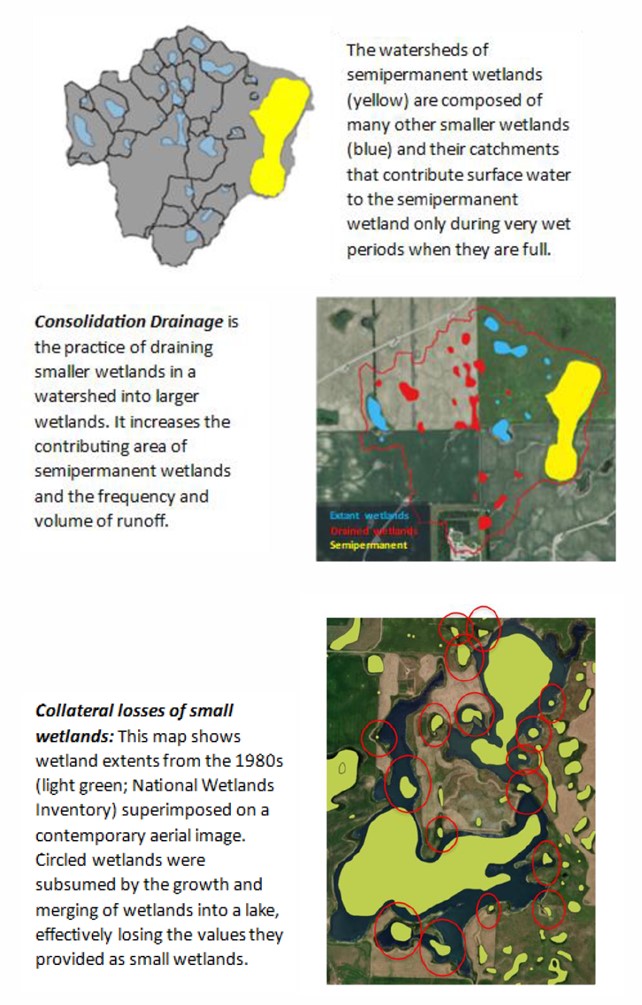
Figure 2. Example processes by which wetlands may be changing. Photographs by the U.S. Geological Survey.
Implications for ducks: Semipermanent wetlands provide critical habitat for ducks during mid to late summer for brood rearing and feather molt for adults after smaller wetlands dry up. Within semipermanent wetlands, deep marsh habitats with submerged aquatic vegetation provides abundant invertebrate forage for ducks, while interspersed emergent vegetation provides security. When semipermanent wetlands become interconnected lakes, they have less aquatic vegetation and provide fewer invertebrate foods and less security for ducks and their broods. Additionally, interconnected lakes often have fish which further degrades their utility for ducks. Without semipermanent wetlands on the North Dakota landscape the state would produce far fewer ducks.
Implications for North Dakota infrastructure: When wetlands increase in size, they often flood homes, farmsteads, businesses, roads, and railways. Moreover, the issues scale up over higher- order watersheds, because when water levels of a wetland reach their spill point, they shed more water to the higher-level watersheds5,13. This spillover magnifies flooding issues on the larger landscape and likely contributes to flooding of Devils Lake and the Missouri and Red Rivers. Such flooding has significant economic consequences. For example, Federal and state transportation department have spent hundreds of millions of dollars in North Dakota to raise roads, including around Devils Lake.
Conservation options: While both climate and land use changes are impacting wetlands, it is likely that coordinated watershed-scale conservation activities can mitigate the water level increases from climate change. However, more research is needed to better understand the relative benefits of grassland protection or restoration versus restoring wetlands within semipermanent wetland watersheds. For example, better information on the relative rate and magnitude of effects of changing landscape conditions across different watersheds could help to inform where an approach of resisting the loss of semipermanent wetlands may be possible, and where the impacts are great enough for resistance to be impractical so that an approach of accepting or even directing some areas to shift to interconnected lakes may be appropriate. Such a science-based approach to decision making could support land use decisions that affect agriculture, wildlife habitats, native and economically important sport fisheries, and transportation infrastructure.
Case Study 3 References:
- McLean KI, Mushet DM, Sweetman JN, Anteau MJ, & Wiltermuth MT (2020) Invertebrate communities of Prairie-Pothole wetlands in the age of the aquatic Homogenocene. Hydrobiologia 847(18):3773–3793.
- Cressey RL, Austin JE, & Stafford JD (2016) Three Responses of Wetland Conditions to Climatic Extremes in the Prairie Pothole Region. Wetlands 36(2):357-370.
- McLean K, Mushet D, & Sweetman J (2022) Climate and Land Use Driven Ecosystem Homogenization in the Prairie Pothole Region. Water-Sui 14(19):3106.
- McCauley LA, Anteau MJ, Post van der Burg M, & Wiltermuth MT (2015) Land use and wetland drainage affect water levels and dynamics of remaining wetlands. Ecosphere 6:art92.
- Anteau MJ, Wiltermuth MT, van der Burg MP, & Pearse AT (2016) Prerequisites for understanding climate-change impacts on northern prairie wetlands. Wetlands 36:S299– S307.
- Anteau MJ (2012) Do interactions of land use and climate affect productivity of waterbirds and prairie-pothole wetlands? Wetlands 32:1–9.
- McKenna OP, Mushet DM, Rosenberry DO, & LaBaugh JW (2017) Evidence for a climate-induced ecohydrological state shift in wetland ecosystems of the southern Prairie Pothole Region. Clim. Change 145(3-4):273–287.
- Harp RD & Horton DE (2022) Observed Changes in Daily Precipitation Intensity in the United States. Geophys. Res. Lett. 49(19):e2022GL099955.
- Lark TJ, Spawn SA, Bougie M, & Gibbs HK (2020) Cropland expansion in the United States produces marginal yields at high costs to wildlife. Nat Commun 11(1):4295.
- Cronshey R, et al. (1986) Urban hdrology for small watersheds. TR-55.
- Euliss NH & Mushet DM (1996) Water-level fluctuation in wetlands as a function of landscape condition in the prairie pothole region. Wetlands 16(4):587–593.
- van der Kamp G, Hayashi M, & Gallen D (2003) Comparing the hydrology of grassed and cultivated catchments in the semi-arid Canadian prairies. Hydrological Processes 17(3):559–575.
- McKenna OP, Kucia SR, Mushet DM, Anteau MJ, & Wiltermuth MT (2019) Synergistic interaction of climate and land-use drivers alter the function of North American, Prairie- Pothole wetlands. Sustainability-Basel 11(23).