In concert with that effort, the agency also gathered input on ways to improve the state’s hunting and outdoor traditions that many hold so dear. Department staff continued to work on many of the recommendations from the summit with Gov. Kelly Armstrong and his staff to help turn the tide.
We have been and will continue to make progress on many of these recommendations but notably five large action items rose to the top.
- Reach 1 million acres of PLOTS by 2028 with an emphasis on new grass plantings. This year hunters saw an additional 40,000 Private Land Open To Sportsmen acres on the landscape for a total of 880,000 acres. Included in that acreage total was 5,000 acres of new grass planted.
- The hunting heyday of the early 2000s was in response to a flush of new grass on the landscape from the federal Conservation Reserve Program. But since, North Dakota has dropped from 3 million CRP acres, to just 1 million with more expected to expire. The CRP program, as successful as it was, is determined through the federal Farm Bill and can be difficult to be accepted into and somewhat restrictive for landowners. The Department partnered with the North Dakota Association of Soil Conservation District to apply for Outdoor Heritage Fund monies to pilot the Governor’s Legacy Soil Health and Habitat Program; a state-level program to improve wildlife habitat on marginally productive cropland with broad support from agricultural groups. The goal is to eventually seek dedicated funding to implement the program on a larger scale.
- Many are familiar with the years of debate that led up to the 2021 legislative session and the resulting electronic posting system we’ve now adopted. Each year there has been an increase in use of electronic posting as hunters and landowners alike have gotten comfortable with the process and compliance. This year, eposting topped 14 million acres. In an increasingly digital world, many have suggested allowing customization within this system, such as dates, species, reservations, and so on. As a starting point, the most feasible option to begin to allow some customization, is to allow landowners to preselect the date windows they would like their land to be electronically posted versus an entire season. Hunters should note that if a property remains physically posted, this would not negate that, just as a currently electronically unposted piece could still be physically posted. This option will be available for the 2026 electronic posting season, which begins on Feb. 1 and ends July 1.
- The Department has long worked to connect landowners with depredation issues to hunters seeking opportunity, specifically for coyotes, antlerless deer, and sometimes geese and turkeys. New in fall 2025, the Department developed an application called HuntLink that digitizes this process by providing a species-specific map for landowners who have expressed interest in wanting hunters. At any time, landowners can access their account and remove their listing if their needs have been met or they no longer want to be contacted. The application easily replaces these somewhat manual processes of connecting the two but also has the potential to expand to other species-specific landowner requests.
- With a mission to increase transparency, understanding and communication regarding Department habitat and conservation programs and hunting access initiatives on private lands, the Habitat and Access Stakeholder Group was formed. This group is made up of 24 individuals — six representatives, consisting of three hunters and three landowners, from four districts nominated by the Department. This group will serve as a sounding board for many of the aforementioned initiatives and those forthcoming. This group will serve only as an informational forum with no formal recommendations, voting or lobbying. District meetings were held in October 2025, and the first statewide meeting is slated for early 2026.
Big Game World
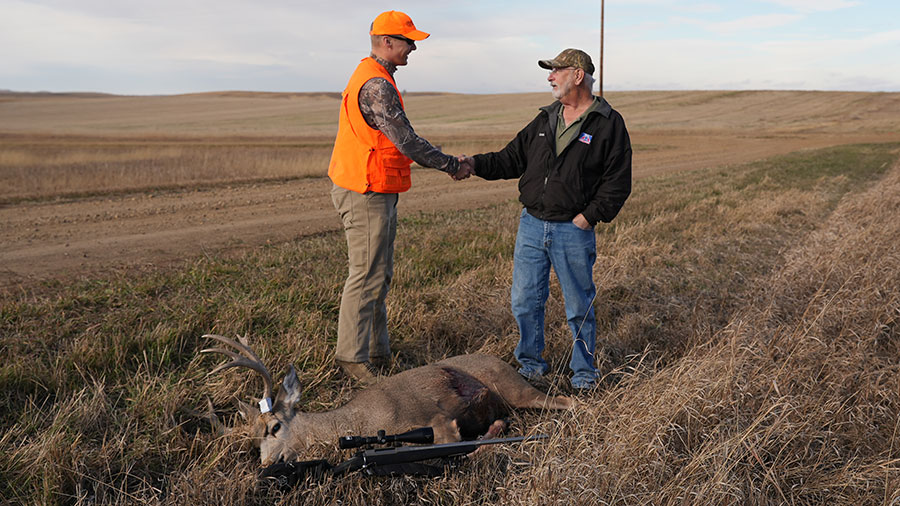 A successful hunter thanks a landowner in southwestern North Dakota during the 2025 deer gun season.
The big game hunting world in North Dakota is an interesting one and it was no different in 2025 when deer licenses were cut by nearly 8,000 compared to 2024. Adequate habitat remains in short supply for deer in the state. To stimulate a rebound, deer, compared to other hunted species, not only need larger expanses of habitat during the hunting season, but need it year-round. While Mother Nature helped us out with back-to-back mild winters, the process is slow, and without adequate habitat that process is even slower.
Also, based on scattered reports of white-tailed deer mortality caused by epizootic hemorrhagic disease that began in early September 2025, the Department allowed hunters with whitetail or “any” deer gun licenses in five units in western North Dakota the option of turning those licenses in for refunds. Hunters who return their licenses had their bonus points restored, if applicable, to the same number of points prior to the 2025 deer gun lottery.
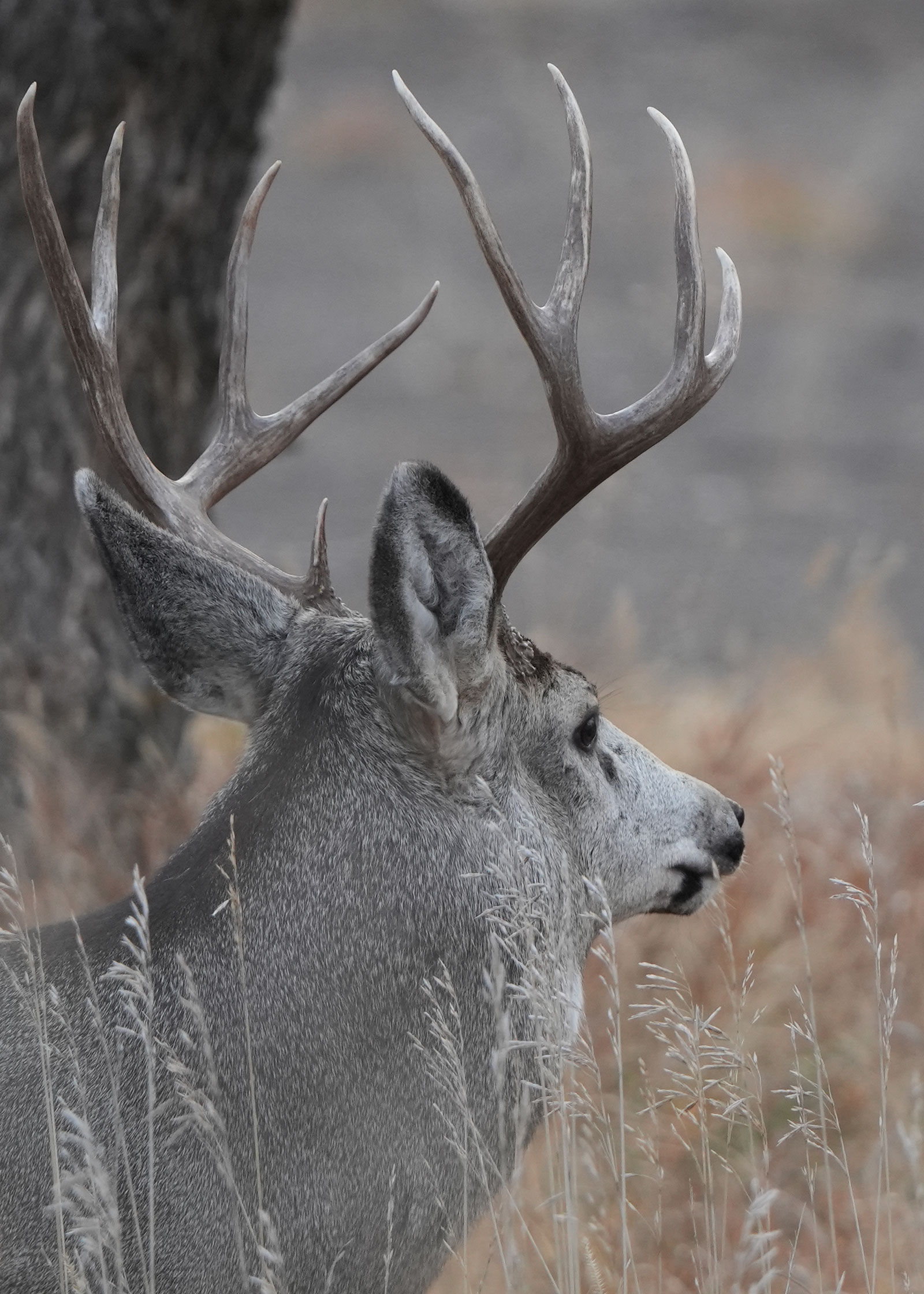
Mule deer continued to hold their own, but some drought conditions, EHD, and maybe even some competition from elk in the badlands continued to slow their rebound. The 2025 mule deer spring index was 14% lower than 2024 and 18% below the long-term average. Mule deer have been stable to declining in the badlands since 2018 due to below average fawn production.
Elk and moose continued to do well, and those unique hunting opportunities were still good in the state. Pronghorn benefited from the easy winter, but they did have some EHD problems last summer and fall that influenced the number of licenses made available to hunters compared to 2024.
69TH Legislative Assembly
Game and Fish Department officials in 2025 tracked as many as 20 bills at the 69th legislative assembly that had the potential to influence, either directly or indirectly, how the Department conducts business into the future.
Notable bills that passed include:
- HB 1470 — Increases the fees of some hunting and fishing licenses, and changes hunting guide and outfitter requirements.
- SB — A waterfowl habitat restoration electronic stamp is required for every resident and nonresident to hunt waterfowl at a fee of $5. In addition, creates a waterfowl habitat improvement fund for improving and restoring waterfowl habitat and supporting youth hunting programs.
Not All Gloomy News
The North Dakota Game and Fish Department’s 78th annual breeding duck survey, which started May 6, was the earliest on record, to match the settling patterns of waterfowl in the state. The May index was 2.6 million ducks; a notable drop and the lowest count since 1994. Still, this number was 7% above the long-term (1948-2024) average, but down 34% from the 1994-2016 average.
Breeding duck numbers typically follow wetland conditions. In 2025, the wetland index was down 38% from 2024 and 33% below the long-term average. Most dabbler species, with the exception of wigeon, saw declines compared to 2024. Mallards were down 26%, and blue-winged teal dropped nearly 16%. The mallard count, while lower than usual, was still the 33rd highest in survey history.
Not all the news was gloomy, though. Diving duck species showed a strong increase, with redheads up 23%, the highest count on record. The total diver index was the highest since 2020 and the second highest in the past two decades.
Spring started off dry, with poor to fair wetland conditions noted across much of the state in early May. After the survey, another challenge arrived as several days of 90-degree temperatures and strong winds dried out the landscape even further. Fortunately, nearly a week of steady rain arrived in the third week of May. Many western and central areas received 4 to 7 inches. Although some large basins remained dry, smaller wetlands were replenished, providing good pair habitat for ducks that stayed in the state. The timely rains helped move wetland conditions back to fair-to-good levels for late-nesting birds, even if the earlier dry spell likely limited how many ducks settled here.
Total wetlands observed during the July duck brood survey were down 50% from an unusually wet 2024 and 22% below the long-term average. Many northern areas of the state remained dry through June and July, but south-central areas received enough rain for good brood habitat. The number of duck broods was up 28% from last year and just 2% below average. Overall, the fall flight forecast was expected to be up 2% from 2024, ranking as the 30th highest in 61 years.
Canada geese that largely nested in North Dakota were down slightly from last year but remained plentiful. Goose production was fair across most of the state, with certain areas experiencing higher nesting success. Other goose species, such as Western Prairie and Tallgrass Prairie Canada geese, snow geese, and Ross’s geese, showed similar trends.
Future Fishing Opportunities
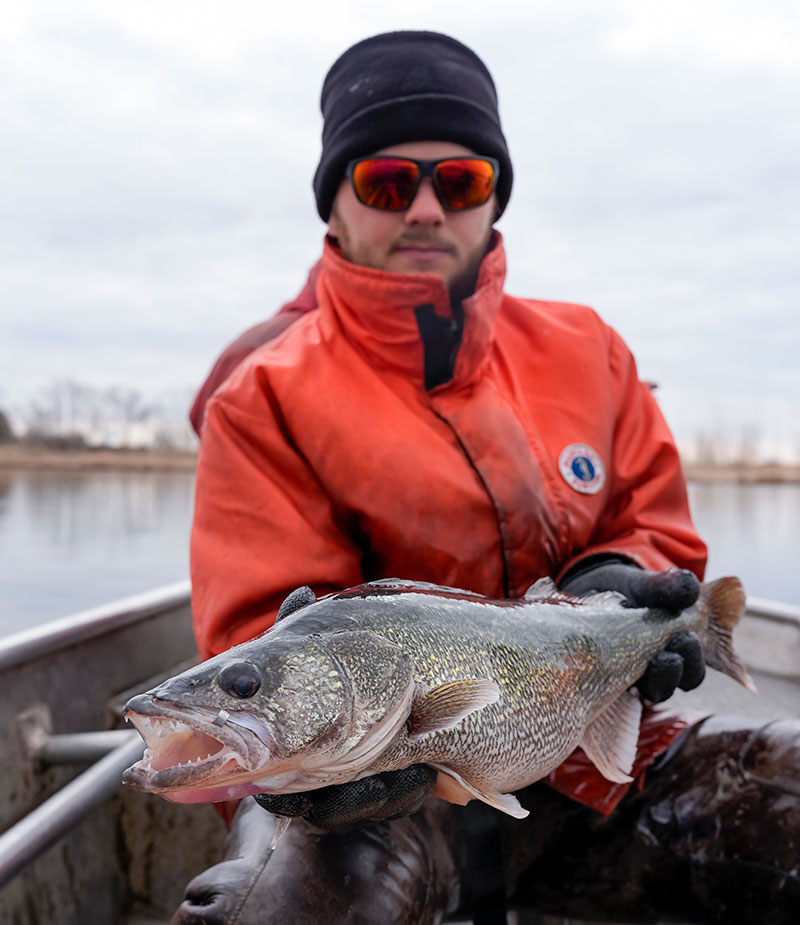 A Devils Lake walleye tagged for study purposes.
During a time when the Game and Fish Department manages about 450 fishing waters in the state and interest from anglers to pursue walleye and other species remained high, Department fisheries personnel continued efforts in 2025 to increase angling opportunities into the future.
For example, Department fisheries personnel took the first eggs during the walleye spawn on April 29 at Lake Sakakawea and Devils Lake. The spawning operations were shut down as egg goals were met at Devils Lake on May 5 and two days later on Sakakawea. Fisheries crews collected 41.2 million eggs at Sakakawea and 28.3 million at Devils Lake.
In spring 2025, fisheries personnel stocked nearly 300,000 4- to 5-inch chinook salmon smolts into Lake Sakakawea. The fish were raised from eggs in the Garrison Dam National Fish Hatchery. To repeat this annual process without pause, Department spawning crews collected 1.2 million salmon eggs in October 2025. The 4- to 5-inch smolts from that batch of eggs will be released into the big lake in spring 2026.
On another fisheries management note, a three-year walleye tagging study was started in spring 2025 on Devils Lake to gain a deeper understanding of how anglers are utilizing the state’s most sought-after species. It had been nearly 20 years since Department fisheries personnel had initiated a study using marked walleyes on this popular fishery.
In addition, fisheries biologists from around North Dakota also initiated one-year walleye tagging studies on six other waters: Lake Addie, Griggs County; Mosher WPA, Barnes County; Horsehead Lake, Kidder County; Davis WPA, Sheridan County; Heart Butte Dam, Grant County; and the Missouri River System from Garrison Dam to Oahe Dam. The latter study was a team effort between the Game and Fish Department and South Dakota Game, Fish and Parks.
Mixed Bag for Upland Birds
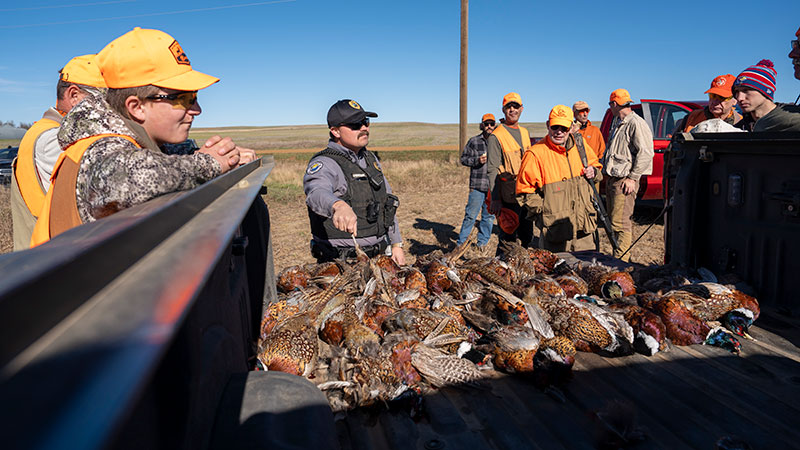 Zach Schuchard, Game and Fish Department warden, Richardton, checks successful pheasant hunters in his patrol district.
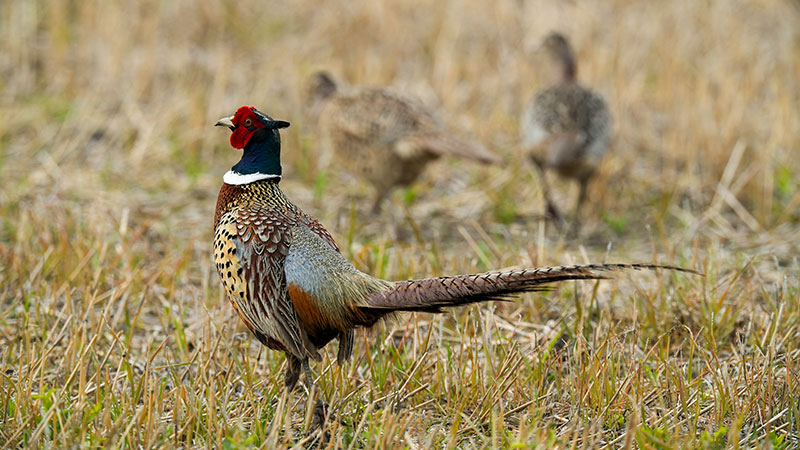
Following another mild winter, the availability of above average nesting cover, but somewhat scattered and sketchy weather events in summer, North Dakota’s roadside surveys conducted in late July and August indicated pheasant numbers were relatively the same as 2024, while gray partridge and sharp-tailed grouse numbers were down.
Total pheasants observed (91.6 per 100 miles) were down 3% from last year and broods (11.4) per 100 miles were down 1%. The average brood size (5.1) was down 6%. The statewide number of pheasants observed per 100 miles was 48% above the 10-year average.
Observers in the northwest counted 14.7 broods and 115 pheasants per 100 miles, down from 20.8 broods and 164 pheasants in 2024. Average brood size was 4.3 chicks.
Results from the southeast showed 9.6 broods and 73 pheasants per 100 miles, up from 7.9 broods and 57 pheasants in 2024. Average brood size was 4.7 chicks.
Statistics from southwestern North Dakota indicated 14.8 broods and 125 pheasants per 100 miles, up from 13.8 broods and 119 pheasants in 2024. Average brood size was 5.8 chicks.
The northeast district, generally containing secondary pheasant habitat with lower pheasant numbers compared to the rest of the state, showed 4.9 broods and 37 pheasants per 100 miles, compared to 4.3 broods and 37 pheasants last year. Average brood size was 4.4 chicks.
Sharptails were down 38% statewide (12 sharptails per 100 miles), and 30% below the 10-year average. Brood survey results showed 2.1 broods per 100 miles and an average brood size of 4.4.
Partridge observed per 100 miles were down 26% (16 partridge per 100 miles). Observers recorded 1.8 broods per 100 miles, and 8.1 chicks per brood.
ZEBRA MUSSELS FOUND
The Game and Fish Department confirmed the presence of invasive zebra mussels in Smishek Lake, Burke County, after detecting zebra mussel veligers in routine plankton tow net samples.
Subsequent follow-up sampling also found additional adult mussels in the lake.
The 195-acre lake is a popular recreation destination located 4.8 miles north of Powers Lake.
Smishek Lake is now considered a Class I ANS infested water. Emergency rules went into effect immediately to prohibit the movement of water away from the lake, including water for transferring bait.
In response to the unwanted discoveries, the Department, in cooperation with state and federal partners and local stakeholders, devised a plan to eradicate zebra mussels from the lake to protect the downstream waters of Lake Sakakawea and lakes in northwestern North Dakota.
In mid-October, Department staff applied an EPA-registered copper-based molluscicide called EarthTecQZ. The product, when applied safely, causes mussel mortality while sustaining other aquatic life. Following the treatment, Game and Fish and Department of Environmental Quality personnel monitored copper concentrations in Smishek Lake.
Bighorn Count Near Record
The North Dakota Game and Fish Department’s 2024 bighorn sheep survey, completed by recounting lambs in March 2025, revealed a minimum of 350 bighorn sheep in the grasslands of western North Dakota, down 4% from 2023 and 6% above the five-year average. Despite a slight decrease from the record count in 2023, the 2024 survey was still the second highest count on record.
Altogether, biologists counted 105 rams, 199 ewes and 46 lambs. Not included are approximately 40 bighorn sheep in the North Unit of Theodore Roosevelt National Park and bighorns introduced to the Fort Berthold Indian Reservation in 2020.
Department big game biologists were pleased to see the population remain near record levels for the seventh consecutive year.
The northern badlands population declined by 4% from 2023 but was the second highest count on record. The southern badlands population increased slightly but remained near its lowest level since bighorns were reintroduced there in 1966.
Biologists were encouraged to see adult rams and adult ewes near record numbers. The streak of four consecutive record counts was broken due to below-average lamb recruitment in 2024, as lambs recruited into the population declined 21% compared to 2023.
The decline in lamb recruitment was likely not related to disease, but a combination of drought, predation and ewes recovering after several years of high lamb recruitment. The state’s adult ewes have invested a lot of energy in rearing lambs the last four years, so sometimes they just need to take a break and concentrate on improving body condition.
Department biologists count and classify all bighorn sheep in late summer, and then recount lambs the following March, as they approach one year of age, to determine recruitment.
Currently, about 480 bighorns make up the populations managed by the Game and Fish Department, National Park Service and the Three Affiliated Tribes Fish and Wildlife Division, just shy of the benchmark of 500 bighorns in the state.
The Game and Fish Department allocated eight bighorn sheep licenses for the 2025 hunting season, one more than 2024.