

Dakota Skipper

Luke Toso/USFWS
Small non-descript butterfly. Ventral wing ranges from a golden color in males to a darker brown in females with some light markings. Can be confused with the Ottoe skipper in which it shares habitat preferences.
Status in North Dakota
Resident.
Range Map
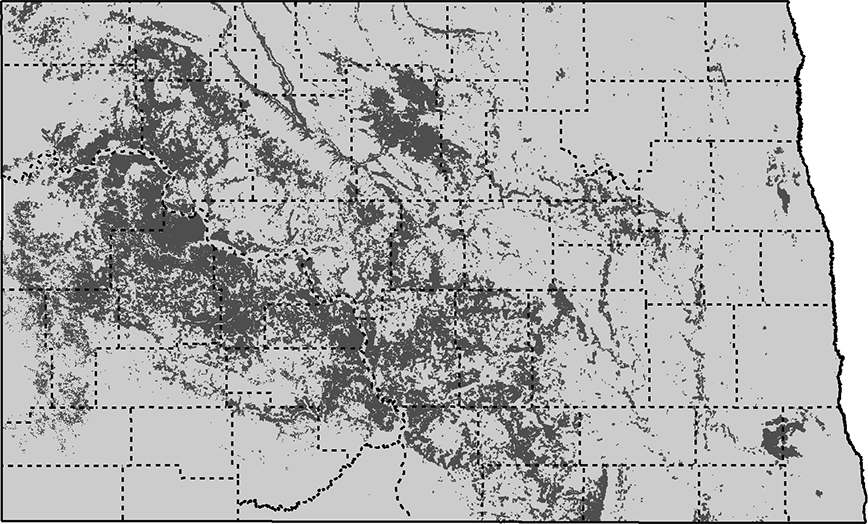
Dakota Skipper primary (dark gray) and possible (light gray) range.
Reason for SWAP Designation
SGCN (a).
Regionally or globally imperiled.
SGCN (b).
At-risk or declining, ND important.
Listed as Threatened by the USFWS.
Loss of habitat is the driving concern.
North Dakota plays an important role in recovery of the species.
Threats
The loss of native prairie is the primary cause for this species decline.
Dakota Skipper are also absent from native grasslands that are intensely grazed or often burned.
Lack of management to suitable sites which allows encroachment of invasive species is also a problem.
This species does not have the ability to move great distance so suitable sites may be absent of Dakota Skipper from lack of immigration from other populations.
The use of herbicide for weed control at certain times of the year in native prairie tracts may be a detriment by reducing nectar sources for the butterfly.
Insecticide use near populations may also a factor.
Research and Monitoring
A Conservation Status was developed by Royer and Marrone for North Dakota and South Dakota in 1992.
Royer, USFWS, and the USFS all conducted early surveys in the late 90s and early 2000s.
The USFWS and the USFS continue to monitor known populations.
The ND Natural Resources Trust, in collaboration with the Dakota Skipper Recovery Council, has received multi-year funding to monitor known populations and survey for new populations.
Survey efforts should continue, even increase, if recovery goals are going to be met.
Management Recommendations
- Protect and manage high quality native prairie.
- Protect and manage known populations.
- Develop pollinator habitat.
- When using prescribed fire to manage do not burn entire area of know population. Use techniques to promote patchy burns. Burn prior to May 1 when possible.
- Delay haying of habitat until after end of adult flight. Leave 8 inches of structure to provide over-wintering cover. Do not hay entire occupied site each season when possible.
- Limit the duration and intensity of grazing in Dakota Skipper habitat. Do not graze habitat for entire season and manage for 8 inches of structure. Spring grazing is preferable. Avoid grazing of nectar sources during the flight period.
- Avoid broadcast spraying of pesticides and herbicides at known sites to minimize loss of adults and nectar sources.
- Monitor known inhabited sites.
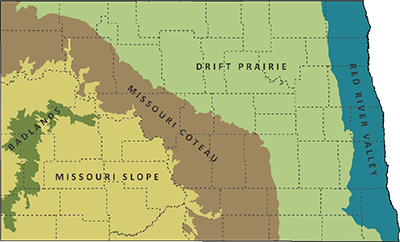
Primary Geological Regions
Habitat Associations
Habitat Use
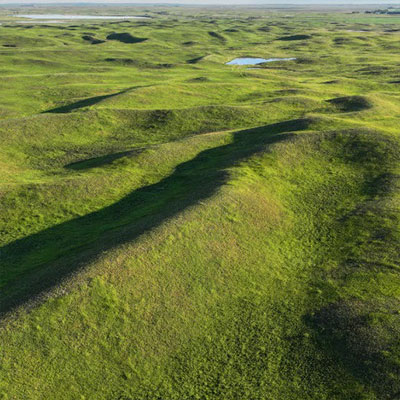
High quality, undisturbed native prairie.
Dakota Skippers can be found in two types of habitats: One is a more mesic prairie consisting mostly of big and little bluestem and flowers such as wood lily, harebell, smooth camas, blazing star, and goldenrod.
The second type is an upland prairie with vegetation that thrives in drier conditions such as needlegrasses (porcupine grass and needle-and-thread grass), side oats grama, and little bluestem with abundant purple coneflower, purple prairie clover, blazing star, and blanket flower.