
Indiscriminate Cuckoo Bumble Bee

Specimen photo from Xerces Society, Rich Hatfield.
Females have yellow faces and T3 and T4 with some yellow along the sides. Males are variable, often T1-T3 are yellow, th a little yellow on T4 and T5. Thorax has a black band between the wings.
Status in North Dakota
Possible resident.
Range Map

Indiscriminate Cuckoo Bumble Bee possible range (light gray). Very few state records.
Reason for SWAP Designation
SGCN (c). At-risk, expert review or recent assessment.
Threats
Cuckoo bees are kleptoparasitic and depend on other bee species to host their young.
Declines of host species play a large role in the declines of cuckoo bees.
The loss of foraging and nesting habitat, as well as the widespread use of pesticides, may also negatively impact the current populations.
Other threats include habitat degradation and fragmentation, naturals pests and diseases, and climate change.
Research and Monitoring
Statewide pollinator surveys have been completed by the USFWS HAPET team and NDSU.
Pollinator surveys should continue throughout the state to determine species range and abundance in ND.
Management Recommendations
- Develop pollinator habitat.
- Protect and manage high quality native prairie.
- Develop connectivity between quality habitats.
- Reduce pesticide use.
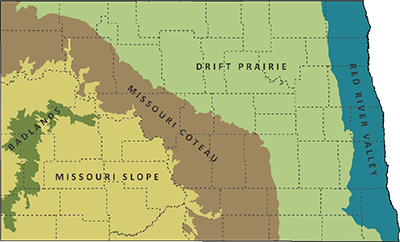
Primary Geological Regions
Habitat Associations

Habitat Use
Native prairie, sagebrush steppe and other shrublands, meadows, and woodland edges.