Unoccupied fish houses must be removed from all waters beginning March 15.
Fish houses may be used after March 15 if they are removed daily.
In addition, anglers are encouraged to look around and clean up the site if any trash is found left behind.
2025 Big 3 Harvest Statistics
North Dakota Game and Fish Department harvest statistics show overall success for the 2025 season was 100% for bighorn sheep, 87% for moose and 62% for elk.
Bighorn Sheep
The Department issued eight bighorn sheep licenses, one of which was an auction license. The Three Affiliated Tribes Fish and Wildlife issued two licenses in 2025, one to a tribal member and one to a Game and Fish Department applicant. All 10 hunters were successful.
Moose
The Department issued 292 moose licenses last year. Of that total, 281 hunters harvested 245 animals – 147 bulls and 98 cows/calves. Harvest for each unit follows:
Unit
Hunters
Bulls
Cow/Calf
Success Rate
M5
7
2
1
42.86
M6
10
8
0
80
M8
15
12
1
86.67
M9
80
33
35
85
M10
114
61
45
92.98
M11
55
31
16
85.45
Elk
The Department issued 1,021 elk licenses last year. Of that total, 929 hunters harvested 576 elk – 280 bulls and 296 cows/calves. Harvest for each until follows:
Unit
Hunters
Bulls
Cow/Calf
Success Rate
E1E
134
33
36
51.49
E1W
191
43
62
54.97
E2
199
59
75
67.34
E3
364
121
121
66.48
E4
22
18
1
86.36
E6
13
2
1
23.08
E7
6
4
0
66.67
Elk, Moose, Bighorn Sheep Applications Online
Elk, moose and bighorn sheep applications are available online at the North Dakota Game and Fish Department’s website, gf.nd.gov. The application deadline is March 25.
A total of 1,062 elk licenses are available to hunters this fall, an increase of 102 from last year.
A total of 296 moose licenses are available, which remains the same as last year.
A bighorn sheep hunting season is tentatively scheduled for 2026, depending on the sheep population. The status of the bighorn sheep season will be determined Sept. 1, after summer population surveys.
Bighorn sheep applicants must apply for a license at the same time as moose and elk, but not for a specific unit. Once total licenses are determined for each unit in late summer, the bighorn lottery will be held and successful applicants will be contacted to select a hunting unit.
Because the bighorn sheep application fee is not refundable as per state law, if a bighorn season is not held, applicants would not receive a refund.
Elk, moose and bighorn sheep lottery licenses are issued as once-in-a-lifetime licenses in North Dakota. Hunters who have received a license through the lottery are not eligible to apply for that species again.
Department Launches Explorer Program
The North Dakota Game and Fish Department is launching a new program to expose high school aged students to what goes on inside and outside the agency’s walls.
The Explorer Program, for students ages 16-18, is designed to engage and mentor youth interested in pursuing a career in natural resources, conservation, law enforcement, and other fields within the Department.
“The program is a great opportunity for students interested in a career in natural resources or the many other things we do at the Game and Fish Department,” said Bill Haase, Department wildlife division chief. “Selected participants will get hands-on experience with wildlife, habitat management, fisheries, enforcement and public outreach.
Haase said the Explorer Program is not only a win for students with designs on following a collegiate path to someday become, say, a fisheries biologist or a game warden, it's also a win for the agency.
“We started the program, in part, as a way for the Game and Fish to recruit future staff,” he said. “Many of the people who currently work for our agency started as seasonal employees. This program will expose students to our careers and possibly become seasonal employees for us and hopefully become permanent staff someday.”
To be selected for the Explorer Program, Haase said applicants start by filling out an application on the Department’s website. Applicants will also need to provide a letter of reference from a counselor or teacher.
The deadline to apply is March 22.
More details about the program, such eligibility, core program activities and expectations, can also be found on the Department’s website.
Game and Fish Offers Wildlife Food Plot Seed
The North Dakota Game and Fish Department is once again offering free seed for the 2026 growing season to landowners interested in planting wildlife food plots for pheasants and other wildlife species.
Rather than a traditional corn or sunflower food plot, Game and Fish is offering a seed mix that provides increased plant diversity, including flowering plants from spring through fall, which will attract insects, the major diet component of pheasant chicks. Additionally, the mix will provide needed cover during spring and summer, as well as a winter food source.
This food plot campaign does not require a department Private Land Open To Sportsmen contract, however, participating landowners are encouraged to allow reasonable public access. This could mean simply providing permission to hunters from time to time, utilizing custom dates in electronic posting, putting up “Ask Before You Enter” signs around the area, or not posting the surrounding land. Additionally, participating landowners cannot charge a fee for hunting.
The department will provide enough seed to cover up to a maximum 5-acre planting at no cost to the landowner.
Landowners interested in receiving the seed must sign up online by April 3. Seed will be available in May at Game and Fish offices in Bismarck, Jamestown, Devils Lake, Harvey, Dickinson, Williston and Riverdale.
Game and Fish private land biologists can provide technical assistance on food plot location and site preparation.
Landowners interested in additional financial incentives may be considered for the PLOTS program. More information is available by contacting a private land biologist at any Game and Fish office, or email privatelands@nd.gov.
2025 CWD Test Results
The North Dakota Game and Fish Department tested 1,224 animals for chronic wasting disease during the 2025 sampling season. Game and Fish confirmed 16 deer tested positive for CWD, all of which were taken by hunters.
Deer that tested positive for CWD came from the following units:
3A1 (five mule deer, one whitetail)
3D2 (two mule deer)
3E1 (one mule deer and one whitetail)
3E2 (one mule deer)
3F1 (one whitetail)
3F2 (two mule deer and one whitetail)
2B (one whitetail)
CWD was not previously detected in units 2B and 3D2.
Game and Fish will use its 2025 surveillance data to guide CWD management moving forward. Regulations related to CWD are set annually by proclamation.
CWD is a fatal disease of deer, moose and elk that remains on the landscape and can cause long-term population impacts as infection rates climb.
The next guide and outfitter written examination is March 28, 2026 at 1 p.m. at the North Dakota Game and Fish Department office in Bismarck. Preregistration is required no later than March 20 by calling the Department’s enforcement office at 701-328-6604.
In addition to passing a written exam, qualifications for becoming a guide include a background check for criminal and game and fish violations; certification in cardiopulmonary resuscitation and standard first aid; and employment by or contract with a licensed hunting outfitter.
Hunting outfitter eligibility requirements include the guide qualifications, as well as an individual must have held a hunting guide license for two years; and must have proof of liability insurance.
The test is given periodically to anyone interested in becoming a guide or outfitter in the state.
Spring Turkey Drawing Held, Licenses Remain
The 2026 spring wild turkey lottery and more than 1,600 licenses remain in 12 units. Remaining licenses are issued on a first-come, first-served basis beginning Feb. 25 at 8 a.m. Central time.
Hunters are allowed two licenses for the spring season.
Licenses remain in unit 04, portions of Billings and Golden Valley counties south of Interstate 94; unit 06, Adams and Bowman counties; unit 13, Dunn County; unit 17, portions of Billings and Golden Valley counties north of Interstate 94; unit 19, Grant and Sioux counties and portions of Morton County; unit 25, McHenry County and portions of Pierce and Ward counties; unit 27, McKenzie County; unit 30, portions of Morton County; unit 31, Mountrail County; unit 44, Hettinger and Slope counties; unit 45, Stark County; and unit 51, Burke County and portions of Renville, Bottineau and Ward counties.
North Dakota’s spring light goose conservation order opens Feb. 21 and continues through May 10.
Residents must have a 2025-26 (valid through March 31) or 2026-27 (required April 1) combination license; or a small game, and general game and habitat license. Resident youth under age 16 only need the general game and habitat license. The 2026-27 license is available for purchase beginning March 15. In addition, all hunters need an electronic waterfowl restoration stamp.
Nonresidents need a 2026 spring light goose conservation order license. The cost is $50 and valid statewide. Nonresidents who hunt in spring remain eligible to buy a fall season license. The spring license does not count against the 14-day fall waterfowl hunting season regulation.
Nonresident youth under 16 can purchase a license at the resident fee. A federal duck stamp is not required for either residents or nonresidents. Yet, like resident hunters, nonresidents also need an electronic waterfowl restoration stamp.
Resident and nonresident licenses are available online at the North Dakota Game and Fish Department website, gf.nd.gov.
Hunters must register annually with the Harvest Information Program prior to hunting in each state. The HIP number obtained for North Dakota’s spring conservation order is also valid for North Dakota’s fall hunting season. The number can be obtained online on the Game and Fish website.
The spring conservation order is only open to light geese – snows, blues and Ross’s. Species identification is important because white-fronted and Canada geese travel with light geese. The conservation order is closed to whitefronts, Canada geese, swans and all other migratory birds.
Bobcat Zone 2 Closed Immediately
Bobcat hunting and trapping in Zone 2 is closed. The zone’s predetermined harvest limit of eight has been reached. Zone 2 is land east of U.S Highway 83.
The bobcat season in Zone 1 has no harvest limit and is open through March 15.
Electronic Posting System for Private Land Available
New this year, landowners have the option to electronically post their land from Aug. 1-July 31 (entire season); Aug. 1-Nov. 22 (through deer gun season); or only during deer gun season (Nov. 6-22).
Landowners who have a profile on the Game and Fish Department’s mobile application have the option to communicate with hunters using their cellphone app. A link will be available for hunters to send a request to the individual posting the land.
The deadline to digitally post land is July 1, which enables Game and Fish to produce print material and digital content prior to hunting seasons that begin in August.
Landowners who enrolled land electronically last year can renew, add or modify posting designations during the enrollment period. Others posting for the first time might need to create a profile. To post land, proceed to the “Land Parcels/Electronic Posting” section at the bottom of the page and click “Search/Renew Land parcels.” The electronic posting system is linked to land descriptions based on county tax parcel information.
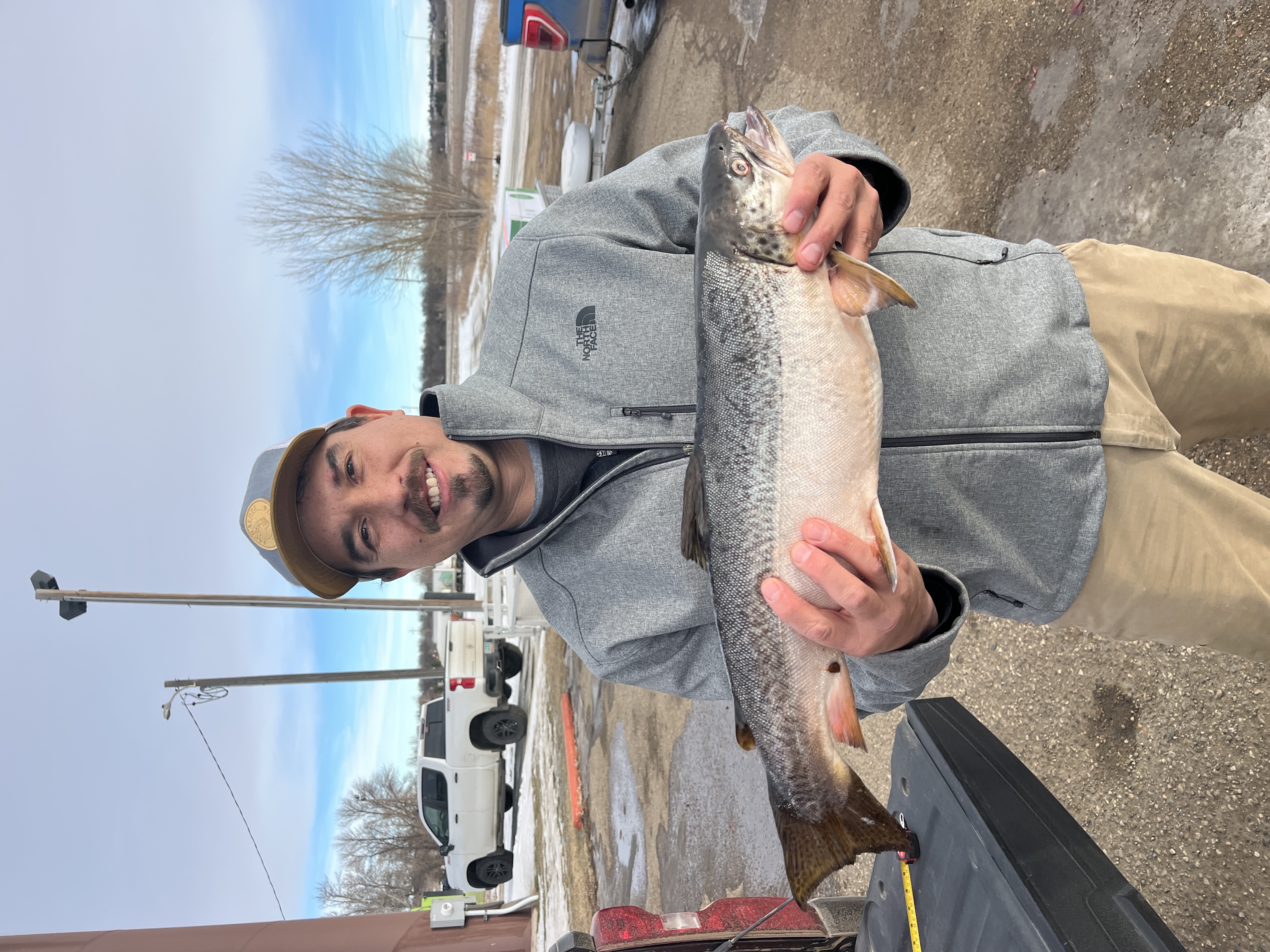
Minot angler Evan Trottier caught a state record tiger trout through the ice Jan. 4 at Hooker Lake in Rolette County.
Trottier’s 6-pound, 2-ounce trout was verified by North Dakota Game and Fish Department personnel. This fish also measured in at 24.75 inches
The Game and Fish Department started stocking tiger trout in 2023 as a novel sport fish in select lakes. Tiger trout are a hybrid between a brown trout and brook trout, known for their namesake striped coloration and fast growth rates in the right environments. Only a handful of lakes in North Dakota contain the right combination of habitat, water quality and forage for tiger trout to thrive.
In spring, the Game and Fish Department plans to stock tiger trout in Hooker Lake and Strawberry Lake in the Turtle Mountains, Moon Lake near Valley City, and the Garrison Dam Tailrace.
Tiger trout stocked in North Dakota waters are obtained through a working partnership with the Wyoming Game and Fish Department.

 North Dakota Game and Fish Department