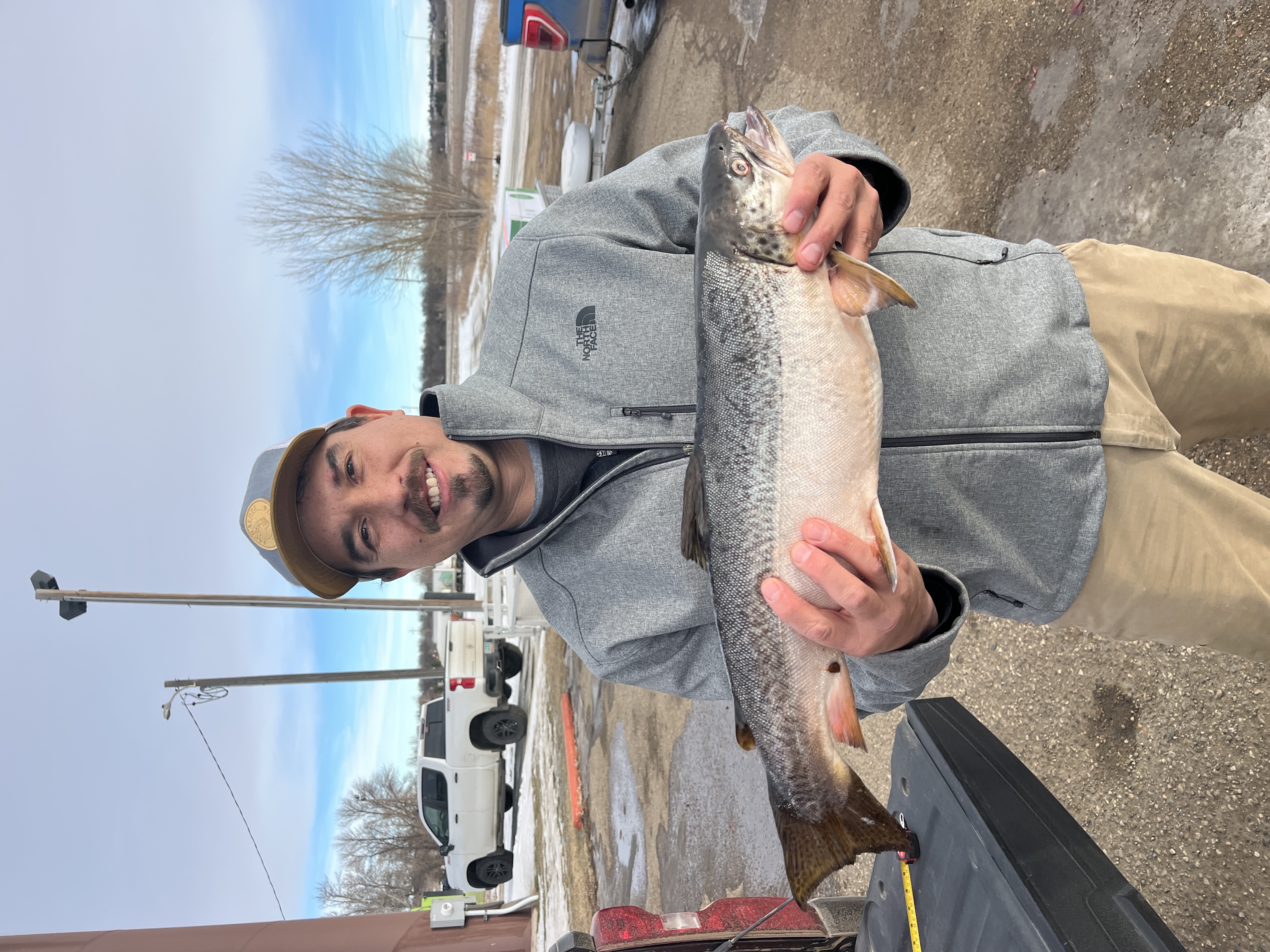
Minot angler Evan Trottier caught a state record tiger trout through the ice Jan. 4 at Hooker Lake in Rolette County.
Trottier’s 6-pound, 2-ounce trout was verified by North Dakota Game and Fish Department personnel. This fish also measured in at 24.75 inches
The Game and Fish Department started stocking tiger trout in 2023 as a novel sport fish in select lakes. Tiger trout are a hybrid between a brown trout and brook trout, known for their namesake striped coloration and fast growth rates in the right environments. Only a handful of lakes in North Dakota contain the right combination of habitat, water quality and forage for tiger trout to thrive.
In spring, the Game and Fish Department plans to stock tiger trout in Hooker Lake and Strawberry Lake in the Turtle Mountains, Moon Lake near Valley City, and the Garrison Dam Tailrace.
Tiger trout stocked in North Dakota waters are obtained through a working partnership with the Wyoming Game and Fish Department.
Tax Checkoff for Wildlife
North Dakotans with an interest in supporting wildlife conservation programs are reminded to look for the Watchable Wildlife checkoff on the state tax form.
The state income tax form gives wildlife enthusiasts an opportunity to support nongame wildlife like songbirds and birds of prey, while at the same time contributing to programs that help everyone enjoy all wildlife.
The checkoff – whether you are receiving a refund or are having to pay in – is an easy way to voluntarily contribute to sustain this long standing program. In addition, direct donations to the program are accepted any time of year.
Midwinter Waterfowl Survey Numbers
The North Dakota Game and Fish Department’s annual midwinter waterfowl survey in early January indicated about 135,000 Canada geese and 9,500 mallards in the state.
Mason Ryckman, department migratory game bird biologist, said numbers were pretty similar to years when Lake Sakakawea is still open, besides the record-breaking number of 300,000-plus Canada geese in 2024.
“Unlike last year when Lake Sakakawea was completely frozen at the time of the survey, this year a portion of the lake remained relatively ice free from Garrison Dam to the mouth of the little Missouri River,” Ryckman said. “We were able to count 39,000-plus Canada geese on the lake this year. We would have probably overwintered more waterfowl if we didn’t receive the snow we did in late November and early December. It likely pushed birds south of the border due to not having access to waste grain in ag fields. However, the snow didn’t last long, which helped the birds that did stay until the time of the survey.”
During the 2026 survey, an estimated 109,112 Canada geese were observed on the Missouri River and Lake Sakakawea, another 16,894 on Nelson Lake in Oliver County, and an additional 8,500-plus geese in other parts of the state. Ryckman said Game and Fish staff and partners with the U.S. Fish and Wildlife Service recorded the additional 9,500 mallards across the state.
The 10-year average (2017-26) for the midwinter survey in North Dakota is 115,950 Canada geese and 13,400 mallards. The survey helps biologists gauge wintering distribution of waterfowl in North Dakota, and other states throughout the Central Flyway.
Turkey Application Deadline
The deadline for applying for the 2026 spring turkey season is Feb. 11.
The Game and Fish Department has made available nearly 8,500 licenses for the spring season that opens April 11 and closes May 17.
Applicants can apply online at the North Dakota Game and Fish Department website, gf.nd.gov.
Spring turkey licenses are available only to North Dakota residents.
A Course Near You
If you were born after 1961, are 12 years or older, you must take an in-person or home study certified hunter education course before you can get a firearm or bowhunting license in North Dakota.
Individuals interested in taking a hunter education class in 2026 must click on the education link at the North Dakota Game and Fish Department website, gf.nd.gov. To register for a class, click on “enroll” next to the specific class, and follow the simple instructions. Personal information is required. Classes are listed by city and can also be sorted by start date. Classes will be added throughout the year as they become finalized.
Those interested in receiving a notice by email or SMS text message when each hunter education class is added, can click on the “subscribe to news and alerts” link below the news section on the Game and Fish home page. Check the box labeled “hunter education” under the education program updates.
Students must turn 12 during the calendar year to take the home study course, and age 11 during the calendar year to take the traditional in-person class.
Earth Day Patch Contest Entry Deadline Nears
The North Dakota Game and Fish Department’s annual Earth Day Patch Contest is an effort to heighten awareness about the environment.
Students who participate will develop a patch design using five colors incorporating an aspect of Earth Day such as environmental awareness, respect Earth, water quality, wildlife, or habitat conservation in North Dakota.
The contest is open to students in grades K-12. Winners are chosen from four grade categories (K-3, 4-6, 7-9 and 10-12). Each winner will receive an outdoor kit, which includes a pair of binoculars and field guides. The grand prize patch design winner is chosen from one of the four winning age categories.
The entry deadline is March 1. Refer to the Department’s website for more information about the contest.
Gear on WMAs
Hunters are reminded that tree stands, blinds, steps and other personal items such as cameras, must be removed from all North Dakota Game and Fish Department wildlife management areas by Jan. 31.
Items not removed by Jan. 31 are considered abandoned property and are subject to removal and confiscation by the Game and Fish Department.
Tentative 2026 Season Opening Dates
The North Dakota Game and Fish Department annually provides its best estimate for opening dates to help hunters prepare for hunting seasons.
Hunters should note the opening date for the regular waterfowl season is still under discussion.
Dates become official when approved by governor’s proclamation. Tentative opening dates for 2026 include:
Season
Tentative Date
Spring Turkey
April 11
Dove
Sept. 1
Deer and Pronghorn Bow, Mountain Lion
Sept. 4
Sharptail, Hun, Ruffed Grouse, Squirrel
Sept. 12
Youth Deer
Sept. 18
Youth Waterfowl
Sept. 19
Early Resident Waterfowl
Sept. 26
Pronghorn Gun
Oct. 2
Youth Pheasant
Oct. 3
Regular Waterfowl
TBD
Pheasant, Fall Turkey
Oct. 10
Mink, Muskrat, Weasel Trapping
Oct. 24
Deer Gun
Nov. 6
Deer Muzzleloader
Nov. 27
Agency Employees Recognized
Holen Named Agency Employee of the Year Ben Holen, aquatic nuisance species coordinator, Jamestown, received the agency’s Director’s Award for professional excellence at the department’s annual staff meeting in December.
Since stepping into the role of ANS coordinator, Holen has demonstrated exceptional leadership, technical expertise, and commitment to protecting North Dakota’s aquatic resources, said Jeb Williams, Game and Fish Department director.
“What truly sets Ben apart is his leadership style. In a program that is often thankless and rarely acknowledged, he maintains an unwaveringly positive attitude,” Williams said. “This positivity is reflected in his team and in the army of temporary staff who feel supported, informed, and valued under his guidance. Ben has become the department’s go-to source for all things ANS, providing clarity, insight, and stability in a volatile and high-stakes program.”
Johnson Earns Two Awards Drew Johnson, North Dakota Game and Fish Department district game warden in Finley, is the state’s 2025 Wildlife Officer of the Year. Johnson was honored by Shikar-Safari Club International, a private conservation organization that annually recognizes wildlife officers in each state.
Scott Winkelman, department chief warden, said Johnson started at the newly created post in Finley in 2019 and his patrol district includes Griggs, Steele and Traill counties.
“Drew spends a great deal of his time patrolling in and around his patrol district by vehicle, boat, snowmobile and ATV. His value to the enforcement division is felt year-round as he patrols his district with enthusiasm for game law enforcement,” Winkelman said. “Warden Johnson’s work ethic and can-do attitude are exemplified in his commitment to becoming more skilled and efficient with each passing year and is a very deserving recipient of this award.”
Johnson was also named North Dakota’s Boating Officer of the Year for 2025. “Drew’s prior work experience on Devils Lake seasoned him into a more successful boat and water safety officer as he had worked extensively on Devils Lake, one of North Dakota’s busiest natural lakes,” Winkelman said. Warden Johnson is dedicated to boat safety enforcement of both recreational boaters and anglers alike.”
Department Awards Jeb Williams, North Dakota Game and Fish Department director, recently honored employees with performance-based awards. The following special recognition awards were presented during the department’s staff meeting in December.
Blake Riewer, enforcement division investigator, Grand Forks, was recognized for consistently providing assistance on complex investigations and handling a significant amount of the behind-the-scenes technical work that is essential in today’s digital investigative environment.
Brian Frohlich, fisheries biological technician, Riverdale, was recognized for stepping in when the Riverdale office was understaffed to oversee all fall sampling for the fisheries district. Frohlich not only met but exceeded expectations by ensuring that sampling was conducted on every district lake that required survey work.
Shane Wegner, data scientist, Colin Penner, private land biologist/GIS specialist, and Kevin Kading, private land section leader, all Bismarck, were recognized for reducing the extensive amount of administrative work required in delivering private land programs in North Dakota. The private land technical teams worked together to optimize workflows by, for example, integrating electronic signatures for contracts and management plans.
Amanda Anstrom, assistant licensing manager, Bismarck, was recognized for her exceptional leadership, dedication and service by skillfully leading the licensing staff, overseeing complex front-end operations including licensing, lotteries and registrations. Jeff Long, education coordinator, Brian Schaffer, hunter education coordinator, and Amber Schroeter, administrative assistant, all Bismarck, were recognized for their outstanding contributions to the department’s education section by consistently executing large, complex events essential to the agency, such as NASP tournaments, volunteer banquet and volunteer training.
Sperling Earns Warden Award Shawn Sperling, North Dakota Game and Fish Department district warden in Minot, was named the National Wild Turkey Federation’s Wildlife Officer of the Year for 2025.
“Warden Sperling’s district contains portions of Ward, Renville and McHenry counties. This area of the state historically boasts a strong population of wild turkeys. Shawn has a passion for turkeys both professionally and personally, as he is an avid turkey hunter himself. Shawn diligently patrols for turkey hunting activity and addresses violations accordingly,” Turkey Federation officials said. “He is also a skilled investigator and has used his talents to make strong cases involving illegally taken turkeys. Warden Sperling’s dedication to the wildlife resources in his district, as well as his district’s constituents, make him a great fit for this award.”
The price to register motorboats under 16 feet in length in North Dakota, and all canoes, is $30; motorboats from 16 feet to less than 20 feet in length is $45; and motorboats at least 20 feet in length is $60. Fees are prorated.
In addition, a $15 aquatic nuisance species fee will be required with each watercraft registration.
New watercraft owners can attach the required documentation, such as the bill of sale or proof of taxes paid, with the online purchase, or send in the required documentation via standard mail. A 10-day temporary permit will be issued to allow for processing and delivery of registration and decals. For timely processing, Game and Fish encourages watercraft owners to submit attachments online.
Fish House Regulations
Any fish house left unoccupied on North Dakota waters must be made of materials that allow it to float. In addition, fish houses do not require a license.
Other fish house regulations include:
Occupied structures do not require identification. However, any unoccupied fish house must have an equipment registration number issued by the North Dakota Game and Fish Department, or the owner’s name, and either an address or telephone number, displayed on its outside in readily distinguishable characters at least 3 inches high.
Fish houses may not be placed closer than 50 feet in any direction to another house without consent of the occupant of the other fish house.
Beginning March 15, unoccupied fish houses must be off the ice by midnight each day.
Free Ice Fishing Weekend
North Dakota’s free ice fishing weekend is Dec. 27-28. Resident anglers may fish those two days without a license. Residents 15 and younger do not need a fishing license at any time of year. All other winter fishing regulations apply.
The weekend provides a great opportunity to try fishing for the first time or take someone new.

 North Dakota Game and Fish Department